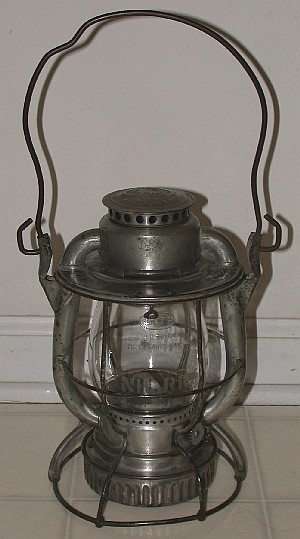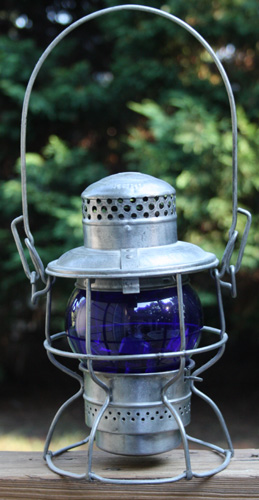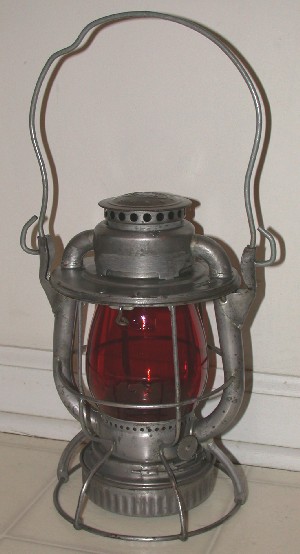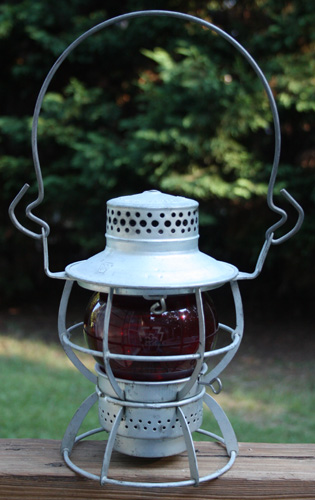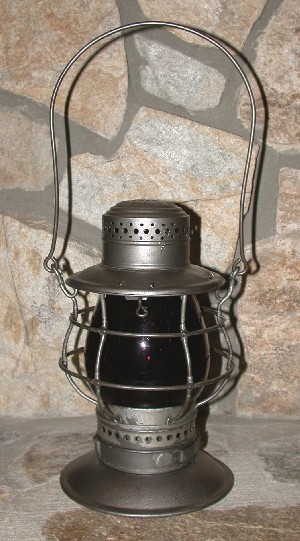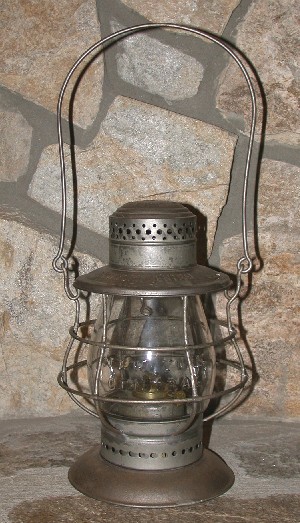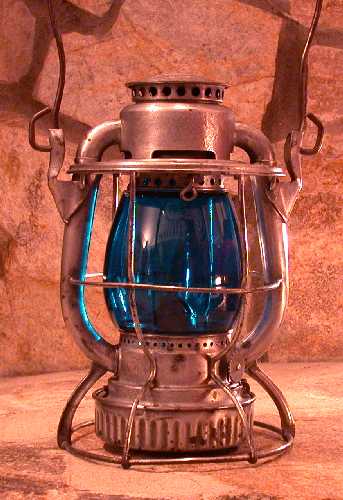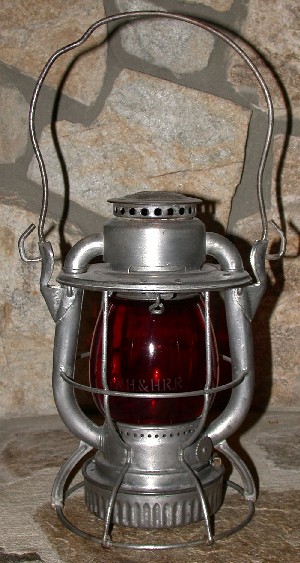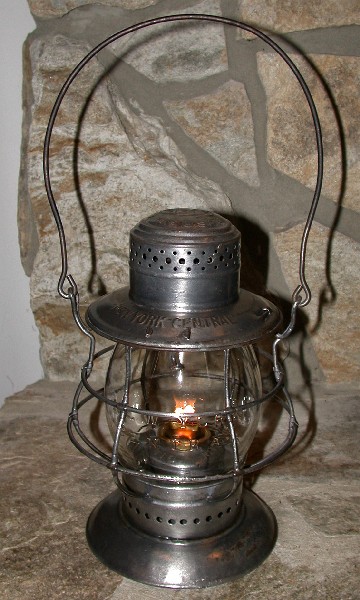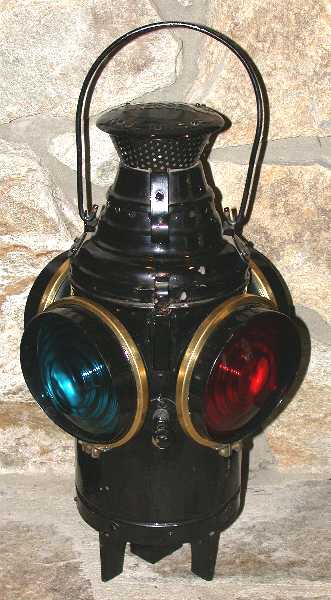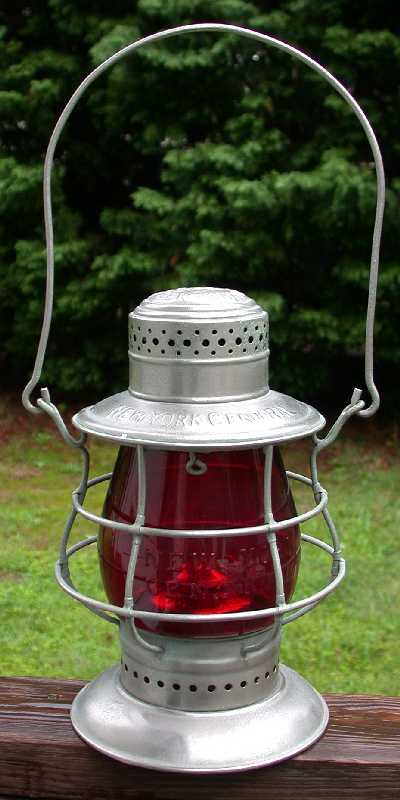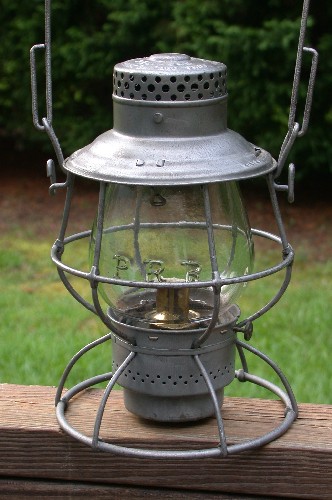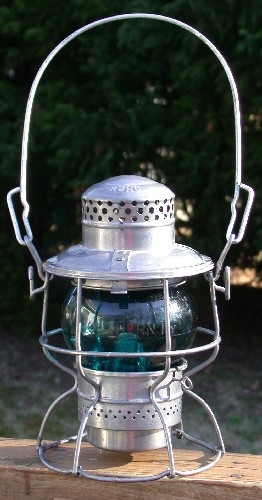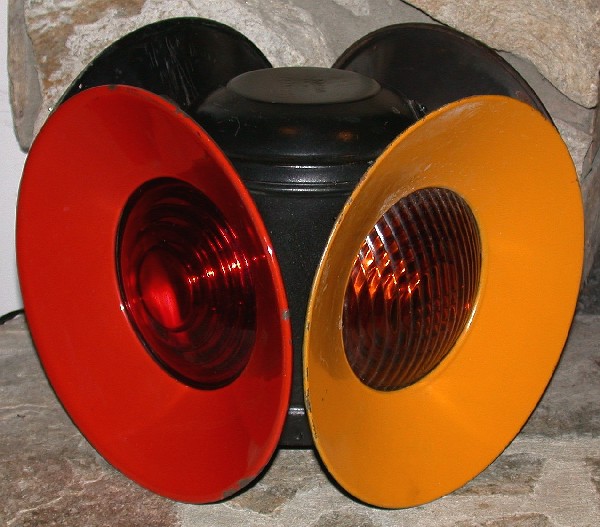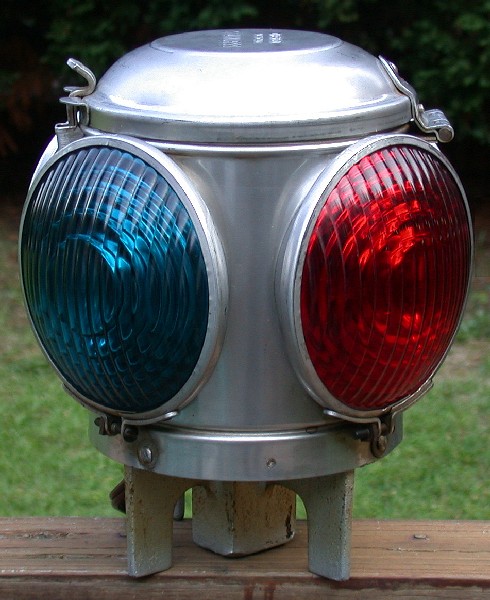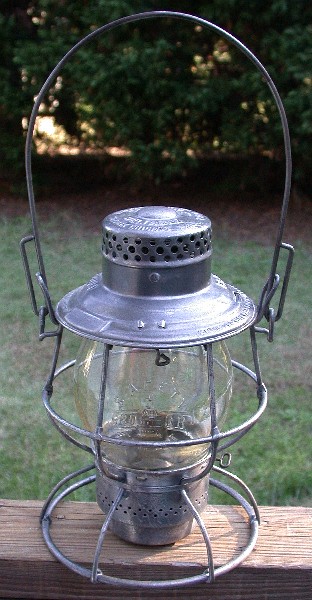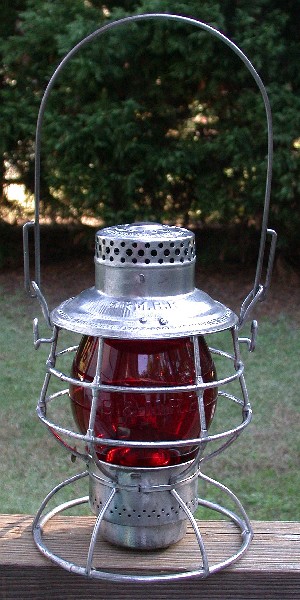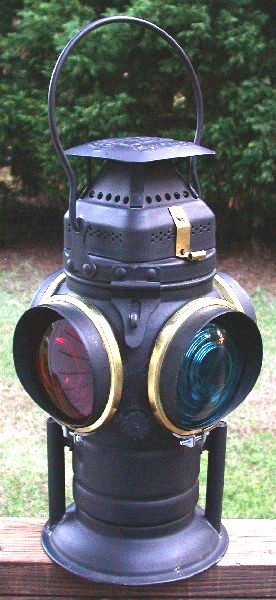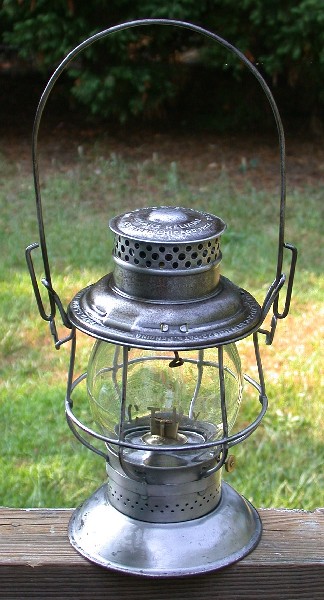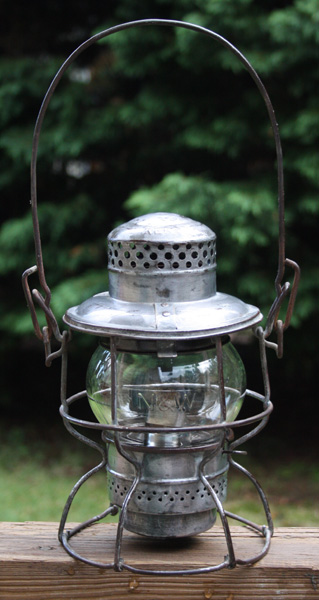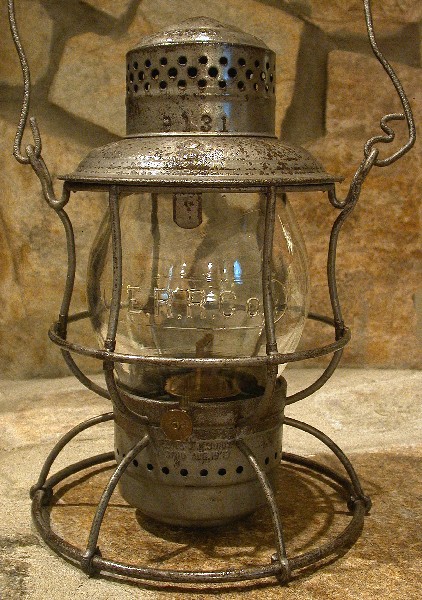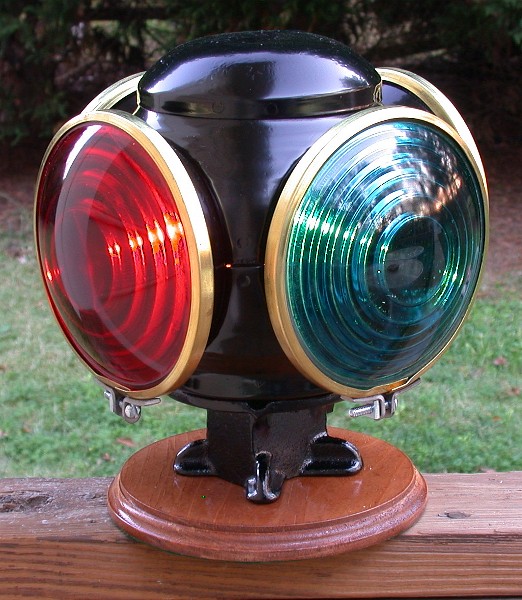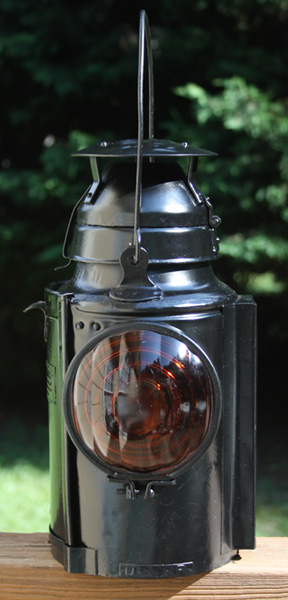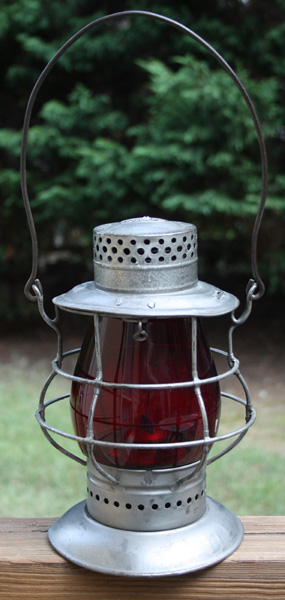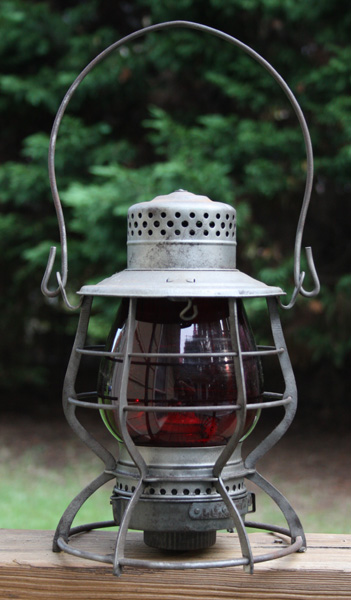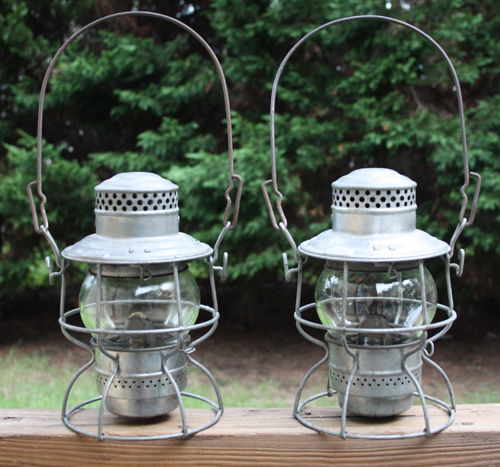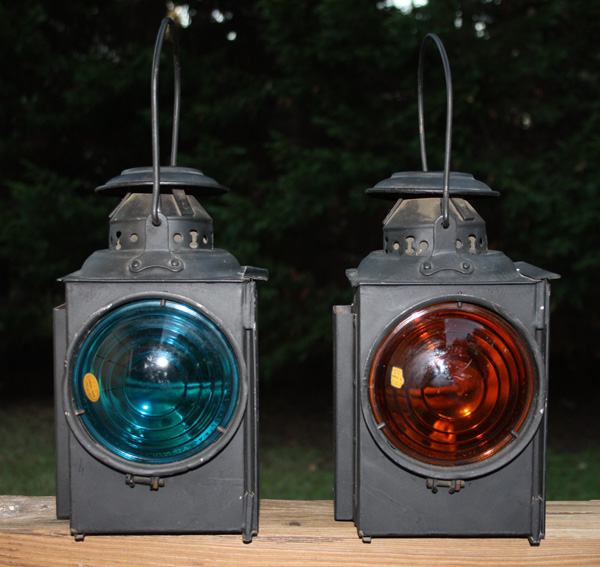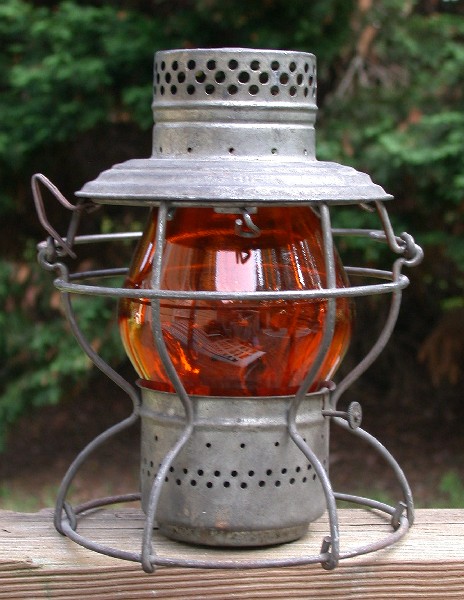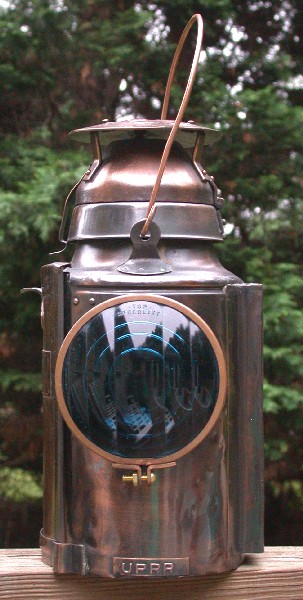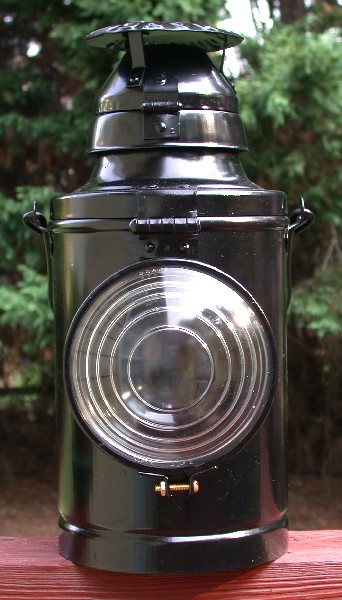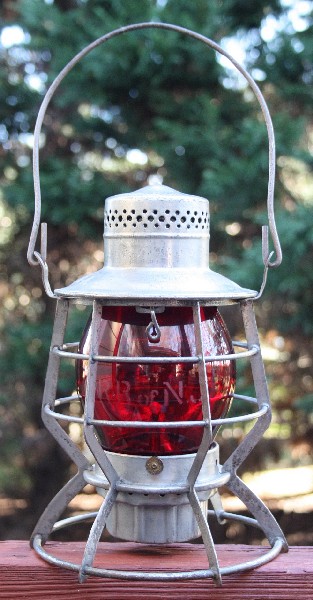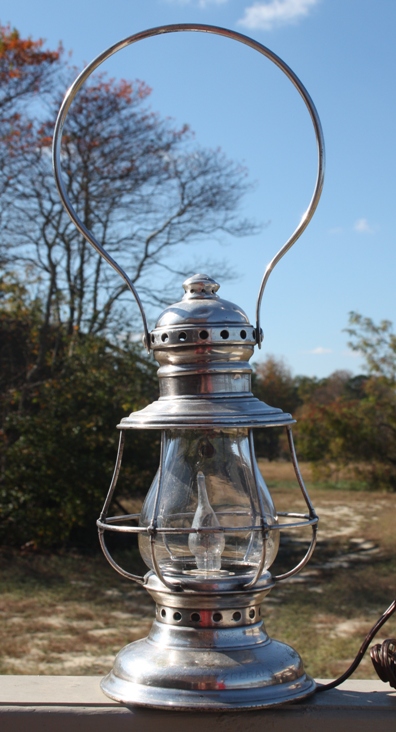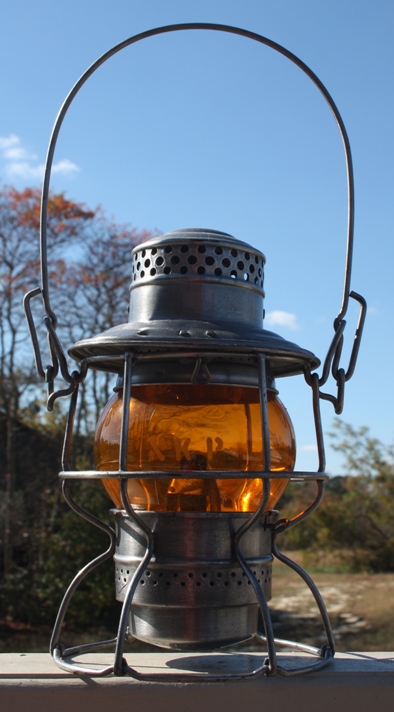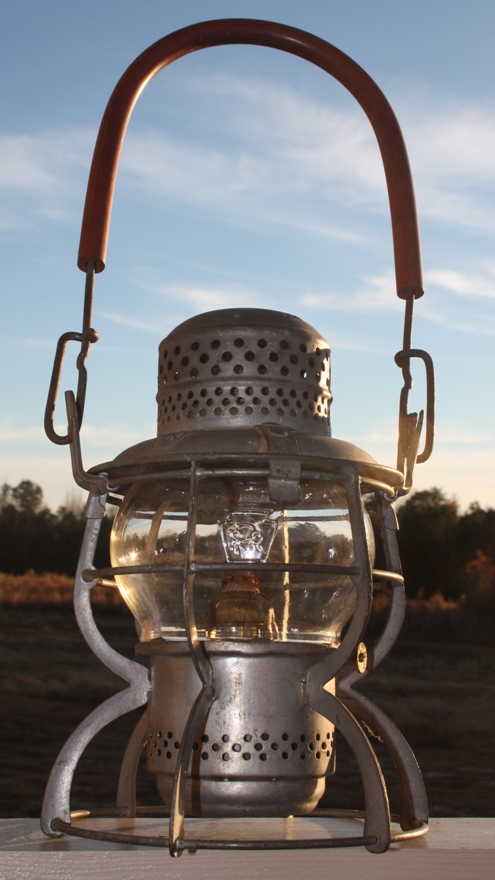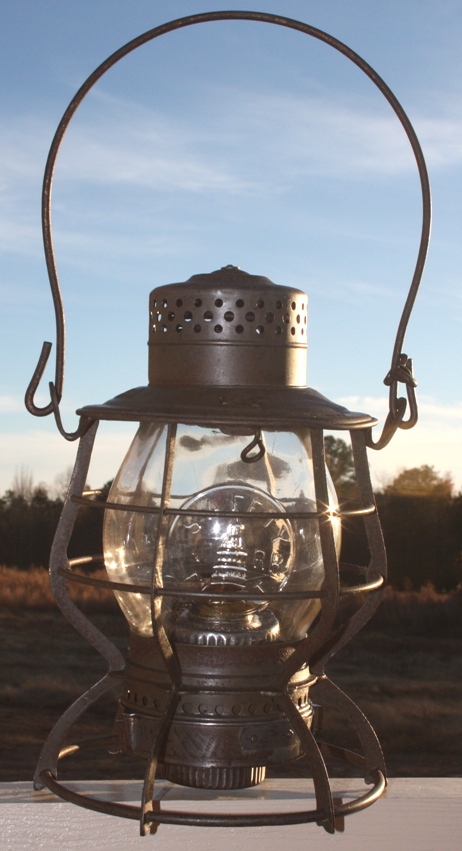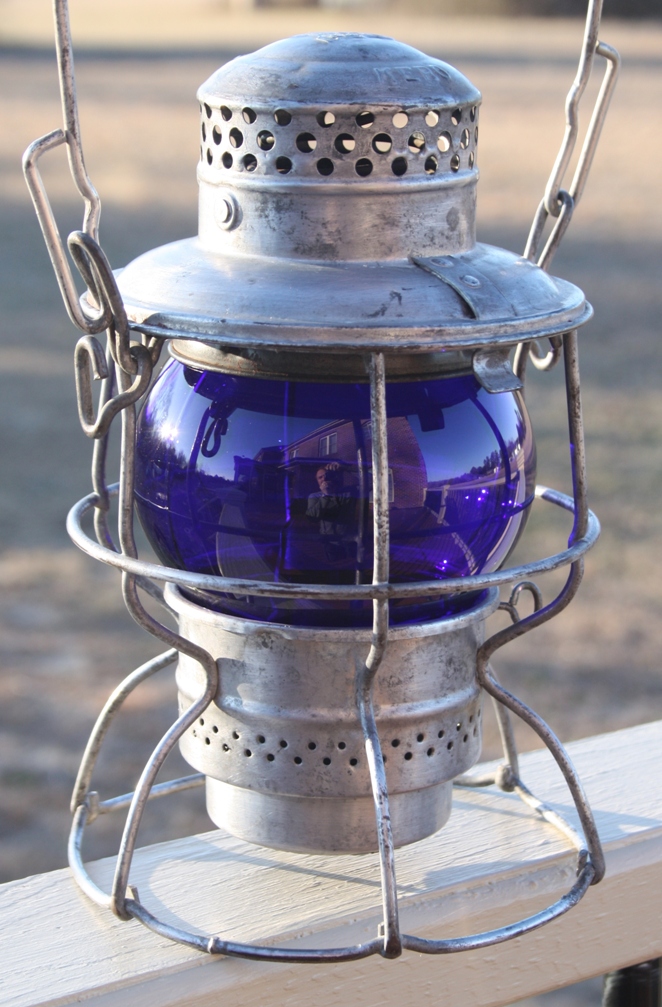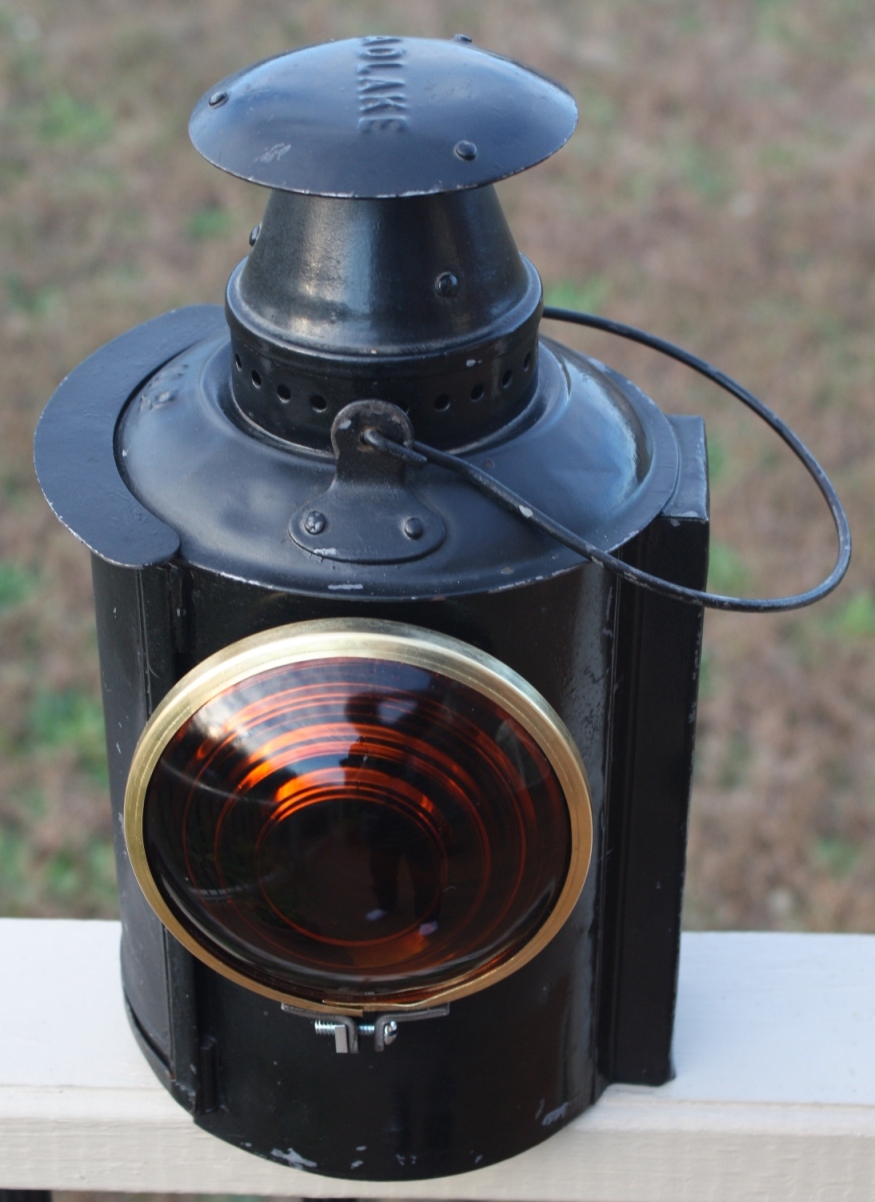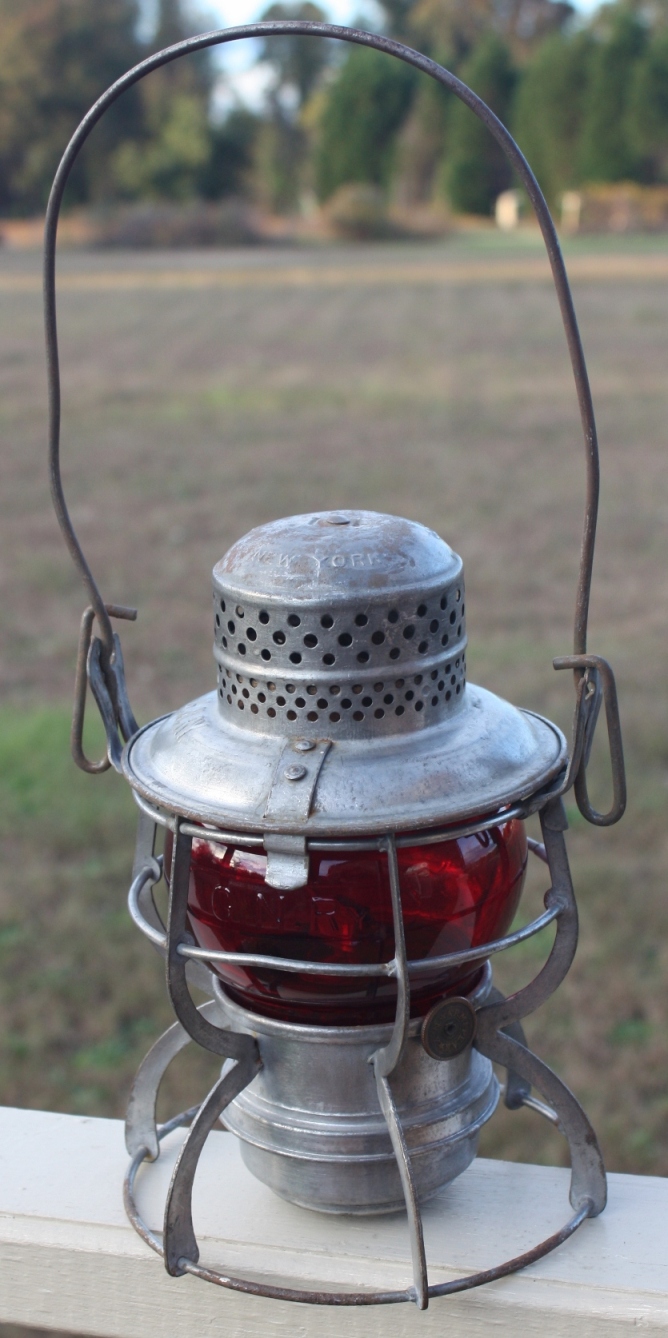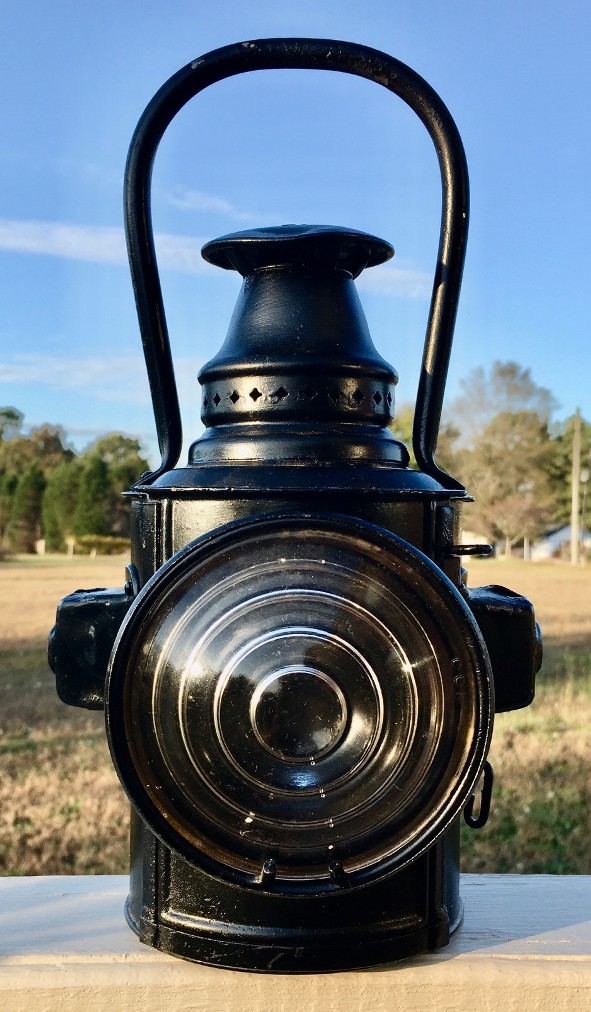
JeffPo's Railroad Lantern Page
Last update: 08/04/26
Welcome to my antique railroad lantern collection website. This webpage is dedicated to my collection of railroad lanterns as well as other railroadiana items. In it you will learn about the various lanterns and lamps used by the railroad. I document how they were used as well as provide information on the railroad line that used it. Do note that while there are battery powered electric lanterns, and electrically powered lamps, my main interest are those that are fuel powered (i.e. kerosene).
The very nature of operating a train and a train yard means that you have to have a means of communication. During the days of steam locomotives and early diesel, the noise and distance involved with train operations pretty much ruled out speaking or yelling, especially since common radio devices weren't yet available. Any device used would also have to be portable, since those working on the line were constantly on the move. While flags and semaphores might work during the day, how about at night? The most effective means of nighttime communications was the kerosene railroad lantern (oil in the earlier days).
The kerosene railroad lantern was a portable, efficient light source, that could be easily seen. Even after electric flashlights began showing up, some railroad workers still preferred the lantern because it lasted longer (i.e. no batteries), gave better light (i.e. the flashlight was too directional), and I've even read about where multiple lamps were used on cold nights to provide for some warmth. At any rate, lanterns have enjoyed a long history with the railroad and today have become collector items for those fascinated with the railroad as a hobby.
And like others who are spellbound by America's history of railroads, I too have entered the fray of collecting railroad lanterns. I guess I should be a little more descriptive. I don't collect in the sense of looking for value or investment. I just like the fact that these devices were used by hardworking blue collar men, on our nation's railways in the dead of night. When I fire up a kerosene railroad lantern, I like to imagine that someone else did the same, decades ago, as they reported for work at the rail yard. While there are electric, battery powered versions, I just think of kerosene versions as more representative of what an antique railroad lantern is all about. I initially created this webpage to share my collection of lanterns and how they were used. Since then it has evolved into historical information about the associated railroads, and other railroadiana items I have collected. Enjoy.
NOTE: I'm a collector only. I don't sell lanterns, parts, or supplies (though I do list some sources). Also, I'm far, far from an expert on the subject. This website just shows my passion for the hobby, not my expertise. There are a couple of sites, listed in my links section, that do have some experts.
Jump to my railroad lantern collection
If you're asking for the value of a lantern...
If you're looking for lantern parts...
If you're offering to sell me your lantern...
If you want to link to my webpage...
Frequently Asked Questions FAQ
Wanted Lantern Items
Lantern versus Lamp
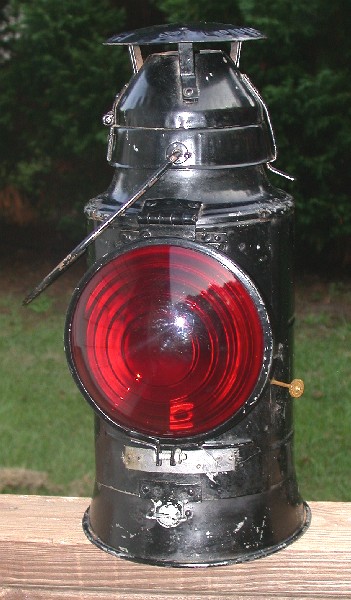
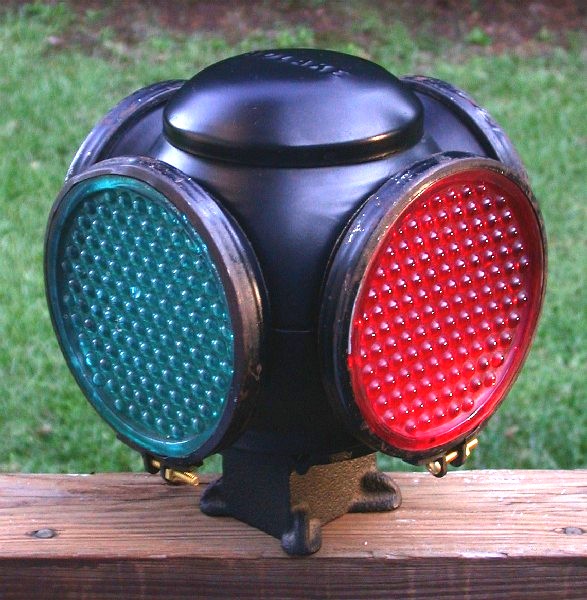
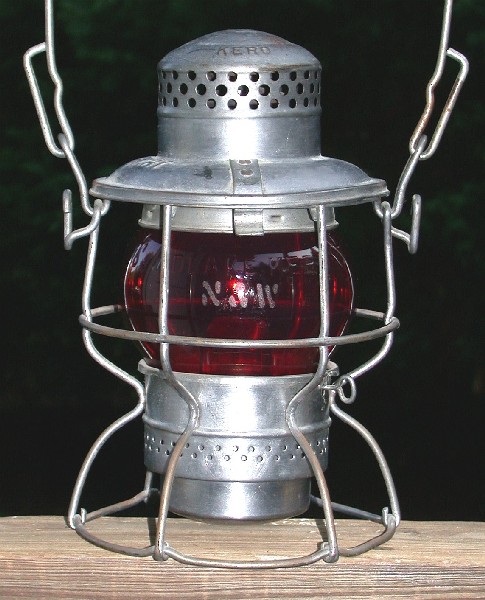
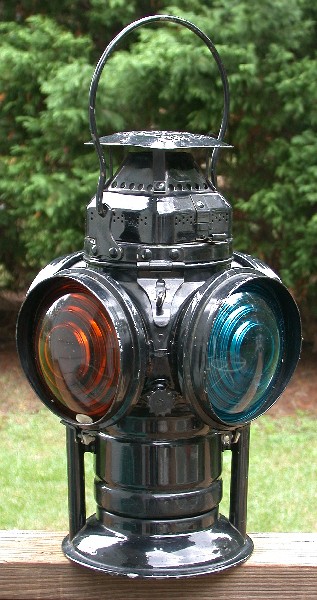
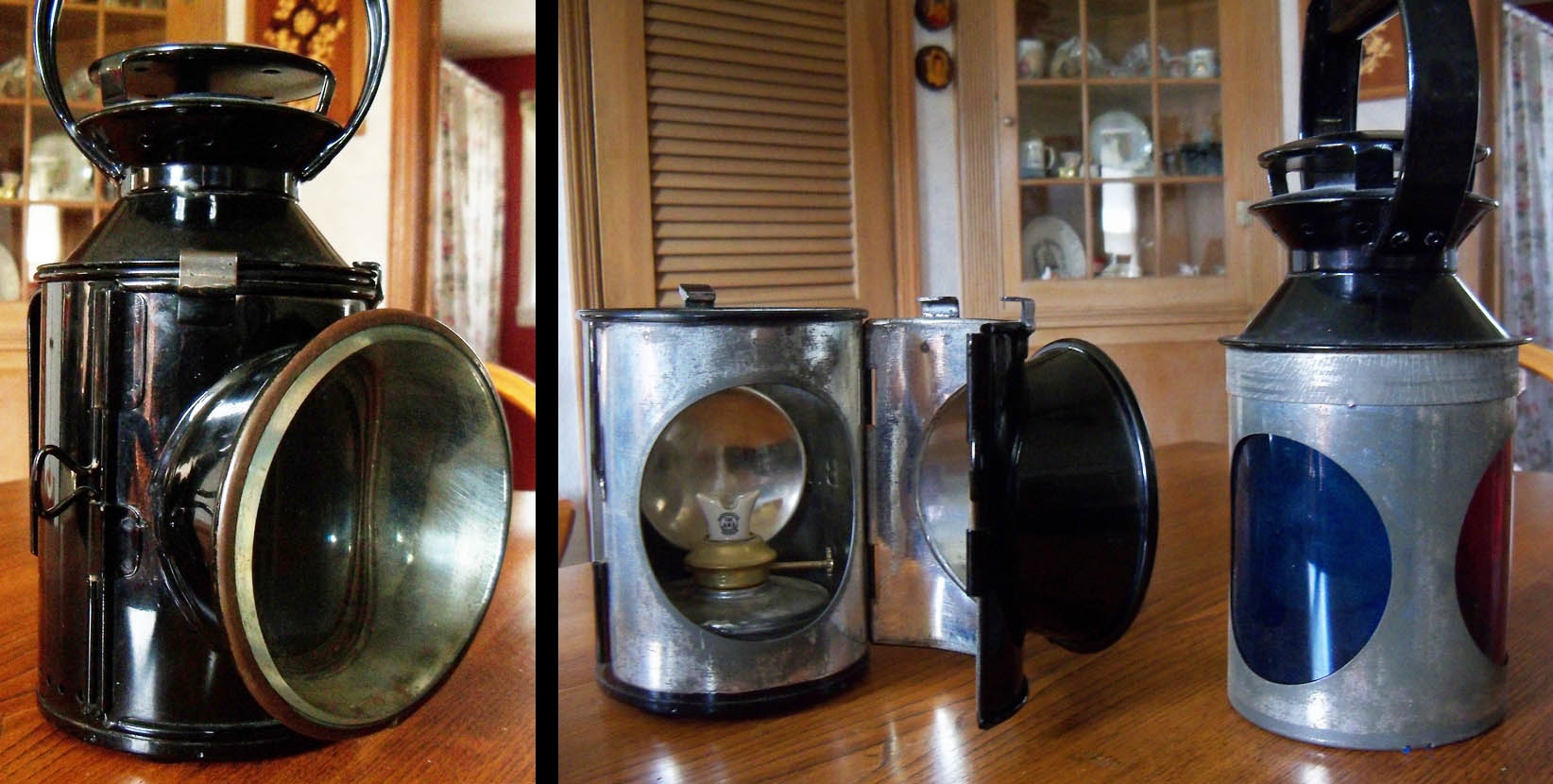
A railroad lantern and a railroad lamp are two different things. Lanterns were designed to be portable (i.e. carried) and were basically globes surrounded by a metal frame with a fuel source. When you think of a railroad worker swinging a signal, think lantern. Lamps on the other hand, generally had a sheet metal or cast metal body and used lenses to amplify the internal light source. They were generally intended to be stationary or mounted somewhere. They are generally bigger and most have lenses to magnify the light. The lamps on railroad track switches or on the back of a caboose as markers are examples. While they may have handles on them for transportation, they were not meant to be swung about like lanterns.

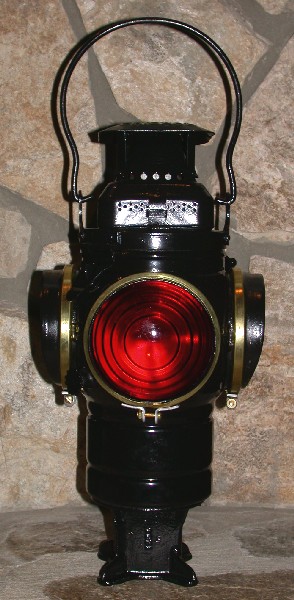
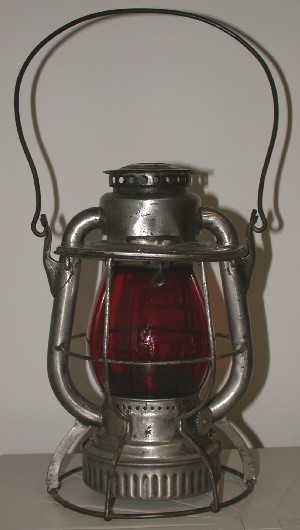
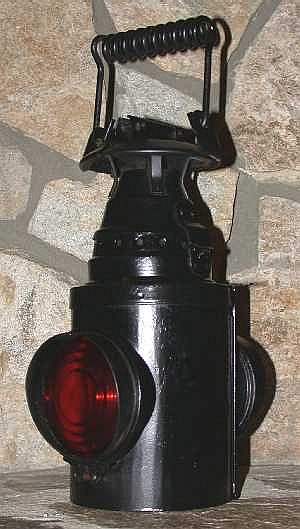
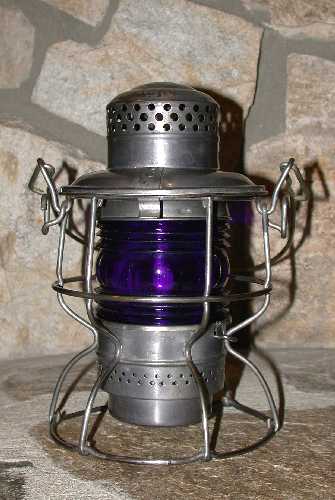
In the image above, looking from left to right, you have a hand lantern made by Adlake, a hand lantern made by Dietz, and a switch lamp made by Dressel. The Adlake lantern is about 9.5 inches tall not including the handle, the Dietz lantern is about 10 inches tall, and the Dressel lamp is about 17.5 inches tall.
The lantern was used by various railroad workers as a hand signaling device. It would be swung in various ways to send a signal, such as stop, apply air brakes, etc.
The lamp would generally be mounted to something. Unlike hand lanterns, which were used primarily at night, railroad lamps were used both day and night.
* A note on the Dietz railroad lantern. The one above is a Vesta model. While it looks similar to the tubular barn lantern styles, it is a bit different. Notice that it has a wire guard to protect the globe. It also has a wire guard around the fuel fount to serve as the base. Normal tubular barn lanterns actually use the fuel fount as their base (see the Dietz Little Wizard model below).
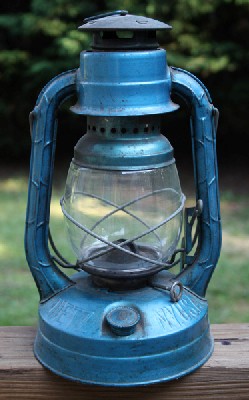
Pictured is a Dietz Little Wizard kerosene lantern that has been in my family for years. You’ll often see people advertise this style of lantern as a railroad lantern. It is not railroad related. Most people refer to these as barn lanterns or utility lanterns. The design is what's known as a tubular lantern. Every now and then you will see a barn style lantern that is marked for a particular railroad, which means that at least that particular specimen was used on the railroad. But without a railroad marking, it can’t be considered as an official railroad lantern. These lanterns were general utility lanterns, used by people at home and by businesses such as construction companies and such. They were also used not only for light, but also as a signal or marker when the globe was exchanged for one that had a specific color. For example, you will sometimes find a utility lantern with a red, amber, or blue globe.
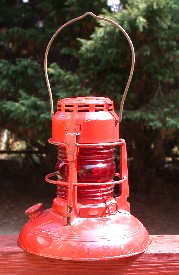
Here's a lantern that is often mistakenly listed as a railroad lantern. This is a Dietz No. 40 Traffic Gard lantern. Yes, "Gard" is spelled without the "u". It has a red fresnel globe/lens. As the name implies, this lantern was used by highway contractors, utility companies, and municipalities rather than the railroad. They were used to mark construction sites and roadwork, and generally warn night time drivers of road hazards. They also used various globe colors such as amber, blue, red, etc., and these colors do correspond to the same signal meanings that the railroad used. For example, red meant to stop, and blue meant that men were working or equipment was not to be moved.
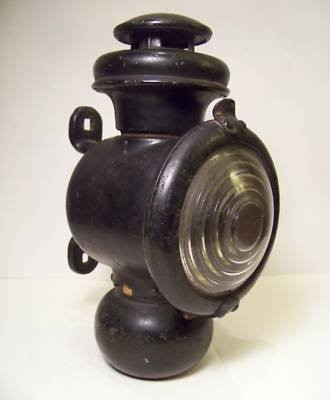
Here's a common lamp that's mistaken as a railroad lantern. It's a Dietz headlight lamp made for a car such as a Model T. They sometimes have a red lens in the back. Or, sometimes the front lens is red in which case it's a rear marker lamp for a car or truck.
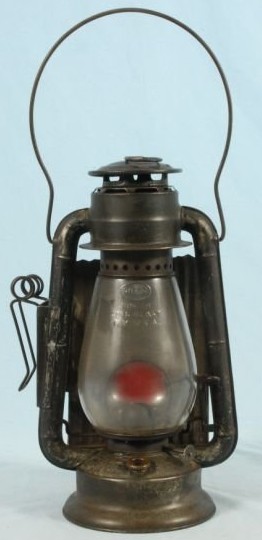
While this has similarities to a railroad
inspector lantern, this Dietz lantern is actually
made for a wagon. Notice the bracket on the side that was used to connect
it to the wagon.
Signals - Hand Lanterns
Various railroad workers, such as engineers and brakemen, used the lantern to signal instructions to others (such as the locomotive engineer). A rail yard is a busy place. Hooking up and rearranging railroad cars took a lot of coordination and proper communication. The lighted kerosene lantern was just the right tool for use at night.
Lantern Globes
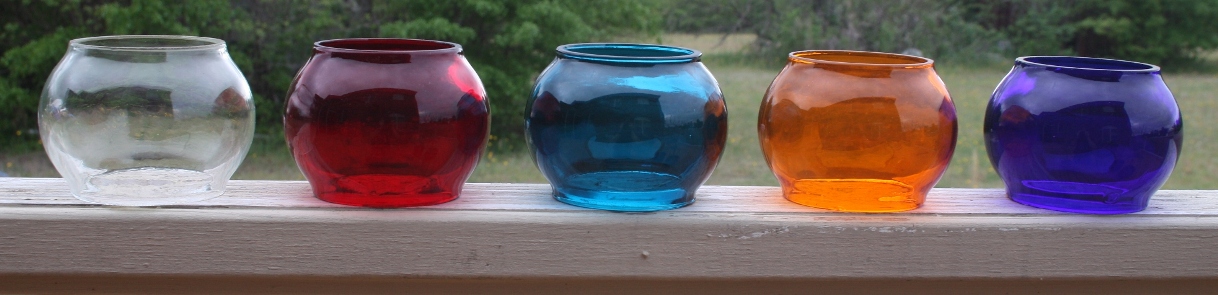
Railroads used five colored globes (clear/white, red, green, yellow, and blue) for their signaling. The yellow globe can range from looking light amber, to yellow, to orange, but officially it is known as a yellow globe. The green globe typically looks like an aqua or teal color in natural light, but will shine a signal green color when illuminated by a yellow kerosene flame. There are a few green globes that look green in natural light. Clear and red globes are the most common.
|
The white/clear lantern was used by the brakeman to give the general, more common signals around the rail yard. They were swung by hand. A white lantern (or a green lantern) could be used to stop a train at a flag station. A flag station is a location where one would want to ride one or two days a week, but would otherwise be too costly for a train to stop everyday if there weren't any passengers. It could be hung from the building or swung by hand. |
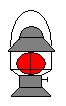 |
The red lantern was generally used to signal STOP.
This could be at the tower, a flag station, etc.
Sometimes a red lantern was hung on the rear of the tender. Sometimes a red lantern was hung on the end of a caboose as a rear marker. A red lantern might also be hung outside the tower to indicate the train needs to stop for Form 31 orders. Orders are instructions from the dispatcher, delivered through the operator, to the engineer and conductor of a train which either gives them the authority to operate, as in the case of an extra train, or modifies the schedule which exists in the timetable. Unlike Form 19 orders, Form 31 orders require the train to stop and the engineer and conductor must each sign for the order. |
 |
The blue lantern was used for marking equipment that wasn't to be moved. It was hung on the various equipment, such as boxcars or locomotives, that were being worked on. |
 |
The signal green lantern was used as a tower signal
for "proceed with caution".
The green lantern (or a yellow lantern) was also used by switch tenders to indicate that the switches were aligned properly. The green lantern was also used by the wreck master (the one in charge at the scene of a wreck cleanup) to signal the wrecker operator and the engineer of the work train positioning the wrecker. The engineer of the wreck train could only act on a green signal given by the wreck master. A green lantern (or a white lantern) could be used to stop a train at a flag station. |
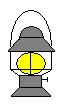 |
The yellow lantern was used to mark "camp cars". Camp cars were railroad cars that track repair men or other repair people lived in when many miles from home. They ate and slept in them. Switch tenders (people that manually threw the railroad switches) also used the yellow lantern (or the green lantern) for signaling to indicate that the switches were aligned properly. A yellow lantern could also be hung as a tower signal to indicate that Form 19 orders were to be handed up to conductor and engineer. Form 19 orders are "hooped" (affixed to a stick with a hoop on it that the engineer could put his arm through to grab it) up to the engineer and conductor by the operator once the train is underway. In other words, the train did not have to stop to receive Form 19 orders. |
To communicate with a lantern, the railroad worker would swing the lantern in various ways according to what message he wanted to send. Some messages could be quite quick and complex, meaning the workers really had to know their signals. They had to give them and read them. They could signal how many cars needed to moved and to where. From what I've read, if you missed or misread a given signal, you were in for an ear full of discipline from the more senior members of the crew.
Below is a set of very common set of hand lantern signals used by railroad workers.
|
STOP
|
Stop signal. Lantern swung back and
forth across tracks. NOTE: Any object waved violently by anyone on or near the track is a signal to stop |
 |
|
PROCEED
|
Proceed or go signal. Lantern raised up and down, vertically. |
 |
|
BACK
|
Back signal. Lantern swung vertically in a circle at half-arm's length across the track. |
 |
|
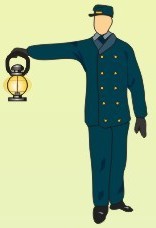
REDUCE SPEED
|
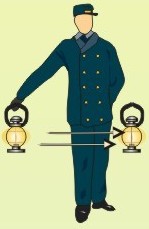
Reduce speed, or slow down signal. Lantern is held out to the side, at arm's length. |
 |
|
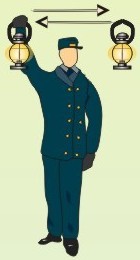
APPLY BRAKES
|
Apply brakes signal. Lantern is swung horizontally above the head. |
 |
|
RELEASE BRAKES
|
Release brakes signal. Lantern is held at arm's length above the head. |
 |
|
TRAIN HAS PARTED
|
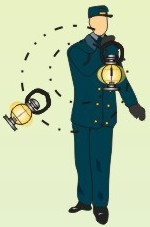
Train has parted or come loose signal.
Lantern is swung vertically in a circle at arm's length across the
tracks. NOTE: While modern trains have made this signal obsolete, it was a very serious signal in its time. It meant part of the train was missing or disconnected and could be coasting into the rail yard and cause a collision/wreck. |
 |
NOTE: The animated GIFs, with the exception of the "train has parted" signal, were provided by Ron Paludan: http://www.trainweb.org/railmation/signals.html. Ron didn't have an animation version of the "train has parted" signal so I created it myself using one of his images as a base image and copying and pasting the lantern arm at various angles to animate the motion. It's crude and not very smooth, but it still conveys what the signal looked like.
NOTE: The still images are from a poster by Daniel Edwards. You can order the poster and other railroad related images at: http://www.a-trains.com/shop/de-poster-rrhandsignalsm/Railroad_Hand_Signals_and_Whistle_Signals_Poster.html
Signals – Lamps
Lamps were mounted in various places to signal traffic moving along the rails. They weren't mean to be handheld signals. Lamps are generally larger than lanterns, and have a much larger fuel fount (for those that aren't electric, or reflector).
Lamp Lenses
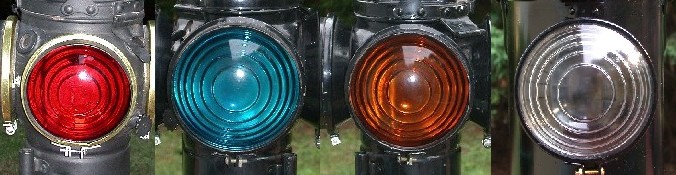
Instead of a singular globe seen from all directions like a lantern has, a lamp would have lenses, shaped like little round saucers, that were more directional with their light. The average size of the lenses ranged from 4" to 5 3/8" in diameter. A lamp could have one, two, three, or four lenses. Lamp lenses came in seven colors. The four main colors generally seen are red, green, yellow, and clear/white. Just like a green globe, the green lens would look teal or aqua blue in natural light, but shine green with a yellow flame. The yellow lens looks more like amber or orange, but it's still officially yellow.
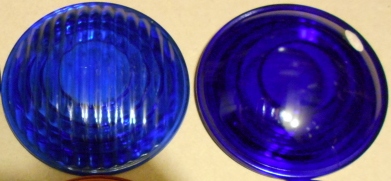
Lunar white on left, purple on right.
The other three colors you'll see are blue, purple, and lunar white. The image above shows a lunar white lens on the left, and a purple lens on the right. They all look like a similar blue in natural light, although the lunar white is a little bit lighter. But with the yellow flame, the purple lens is noticeably more violet than the blue lens. The lunar white lens appears to be pure white with the yellow flame, just like the light of a full moon (hence the name). The lunar white lenses were sometimes used in switch lamps opposite some yellow lenses. The purple lenses were sometimes used on derail lamps opposite some green or yellow lenses.
A blue lens shines with the same hue as a blue globe from a hand lantern. A lamp with a blue lens was used on a "doll arm post". A doll arm post was an extension on a main signal post that had a blue signal on it. It was used when another track intervened between the main signal, and the track that signal governed (i.e. there wasn't enough room between the tracks to put the signal beside of the track it controlled, like it normally would have been placed). I've also heard that a lamp with a blue lens could have been used on RIP track (tracks in a rail yard or along a main rail line where locomotives and/or railroad cars can be placed for minor repairs).
Types of Lamps
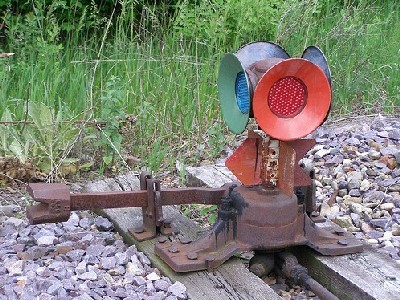
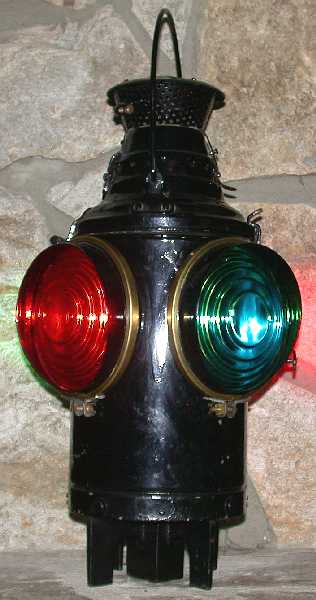
A switch lamp was mounted to a railroad track switch and would indicate (using specific colors) which position the switch was set to. Usually a green signal indicated the switch was set to straight ahead while a red signal indicated that the switch was set to the turn out. Sometimes instead of red, a railroad would used yellow lenses.
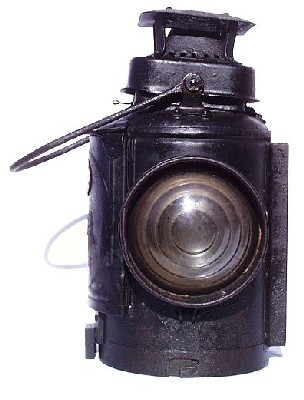
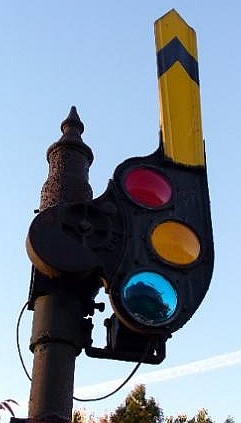
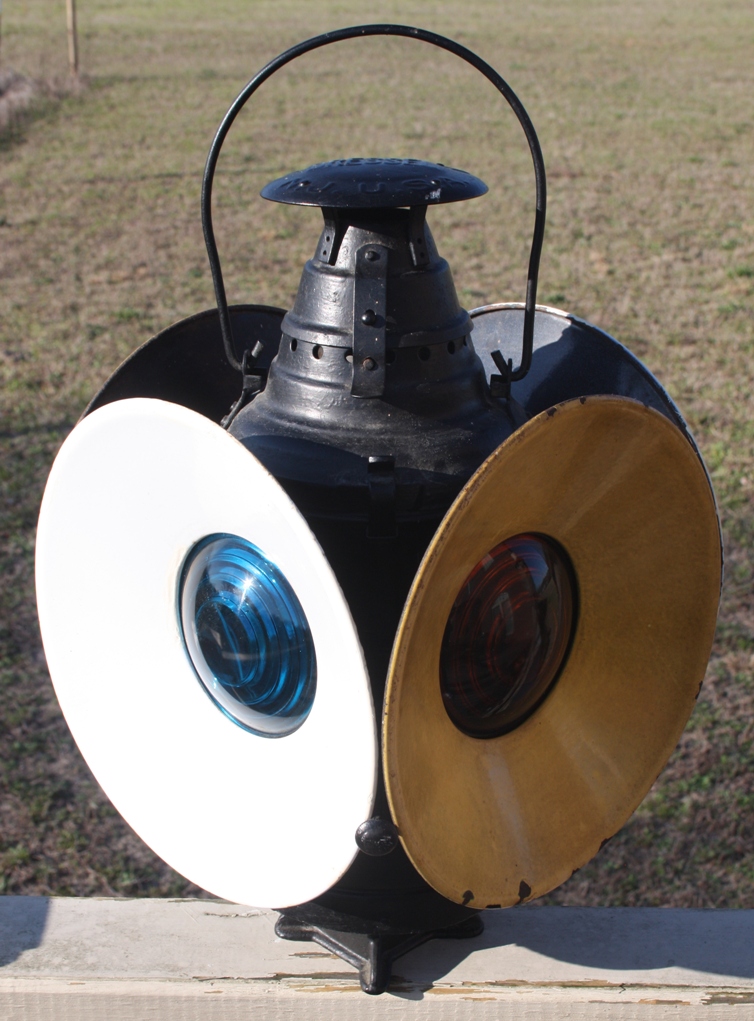
A semaphore lamp was a lamp with a single white lens used to illuminate the colored glass filter roundels of a semaphore blade (see the image to the right of the lamp). The signal could be stop, proceed, or caution/slow based on what color it was.
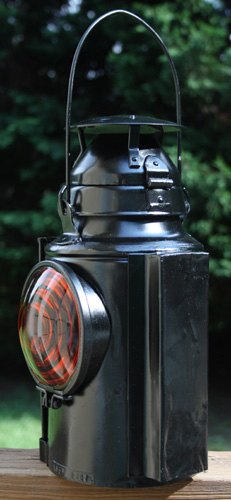
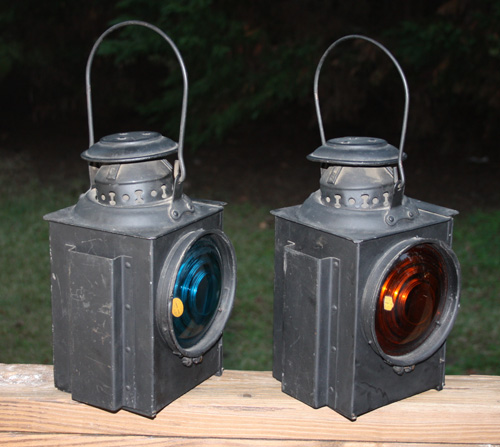
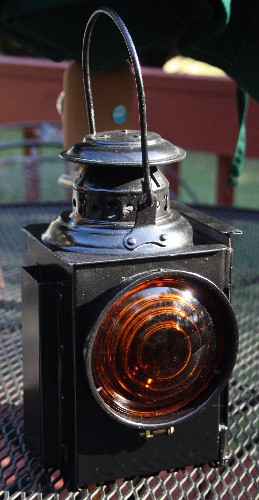
Train order lamps were used in similar fashion to semaphore lamps, but generally had two clear lenses instead (180 degrees apart) for each direction (though some only had one). They would have a semaphore blade on each side. They were used to signal the approaching train to let them know whether or not to stop at the station for train orders, or if there were standing orders for that block of track. There were also more portable versions of train order lamps (shown above) called slow order lamps. These were used by work crews along the railroad line.
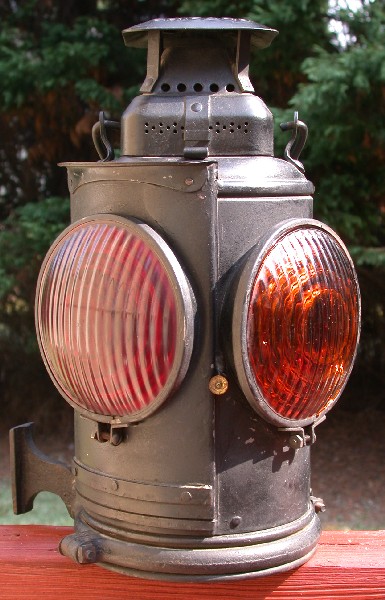
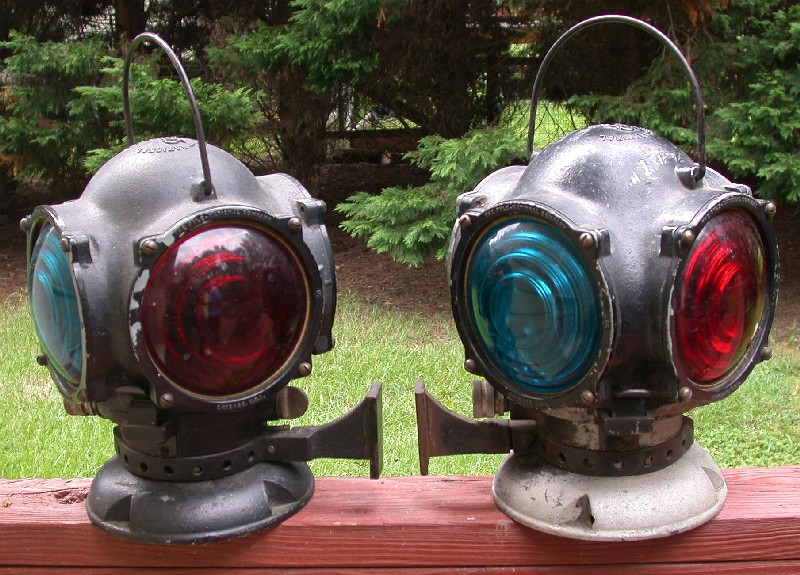
Marker lamps (also called caboose lamps) were mounted on the rear of a train to mark the end car and to serve in some cases as a signal (to passing trains) if the last railcar was completely off the main line and onto a siding.
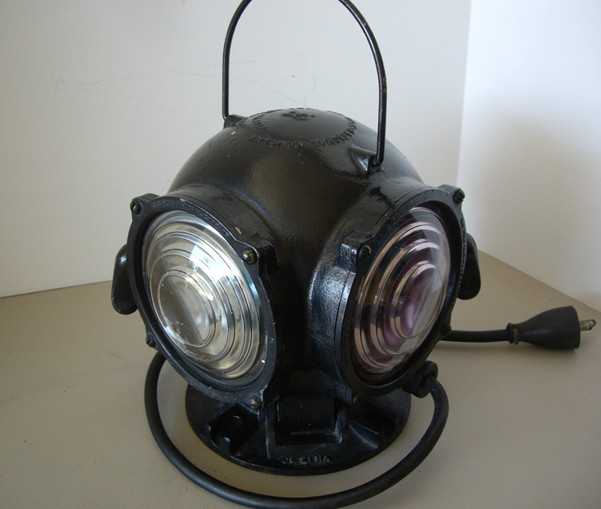
Classification lamps were mounted on the front sides of a locomotive. They had three settings. Off, white, and green. The green signal was achieved by turning a lever that would move green glass discs between the light source and the clear lens. Regularly scheduled trains would show dark (i.e. off) classification lamps. Trains run as extras would show white classification lamps. If a train was split up into more than one section, the preceding sections would show green classification lamps with the last section having an unlit lamp.
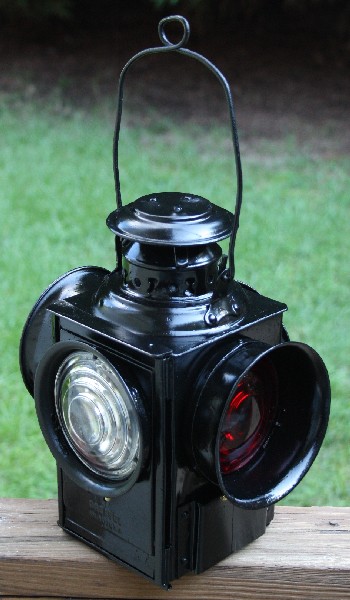
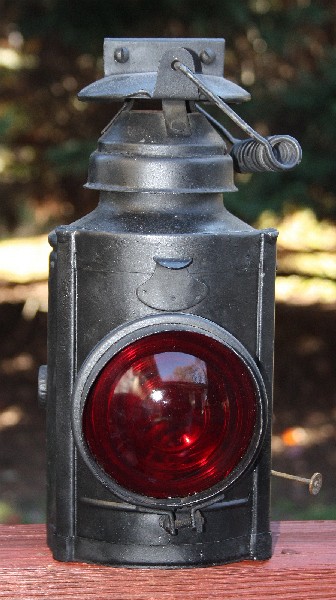
Crossing gate lamps were used as markers at crossing gates. Some used four lenses (two red, two white). Some used two red lenses. And some used just a single red lens. The red lens faced toward the traffic that was to stop for the approaching train.
My Railroad Lantern Collection
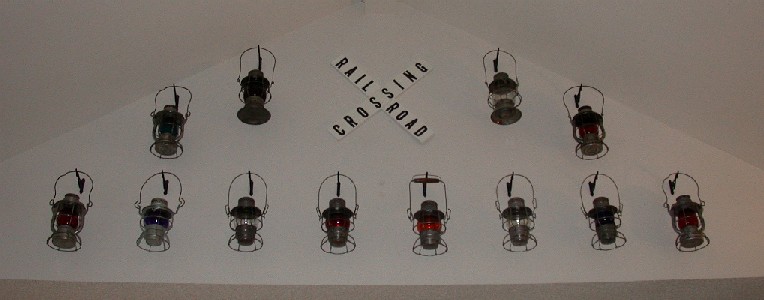
At my previous house, I had some of my railroad lantern collection displayed in my living room, along a wall of my cathedral ceiling. I created the railroad crossbuck to give it more visual appeal. I also had a couple of switch lamps on the fireplace hearth. So far I haven't come up with a display for the new house, other than the occasional lantern sitting here and there, that I actually use for mood lighting. I actually have an office now that I want to use to setup my model trains, so I'll probably do something in there. Maybe use wall shelves instead of hooks.
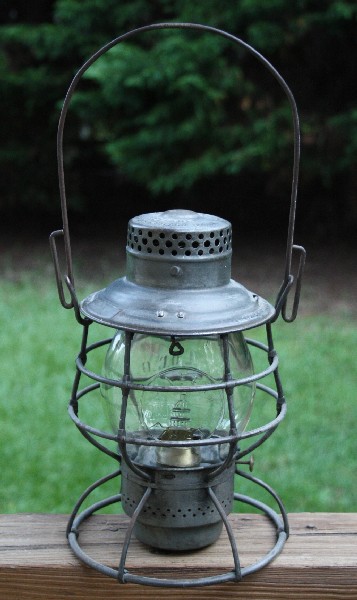
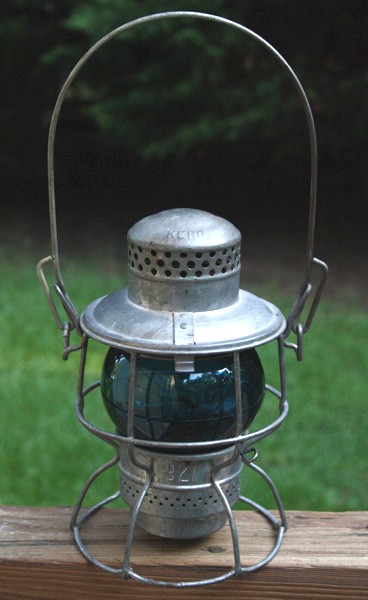
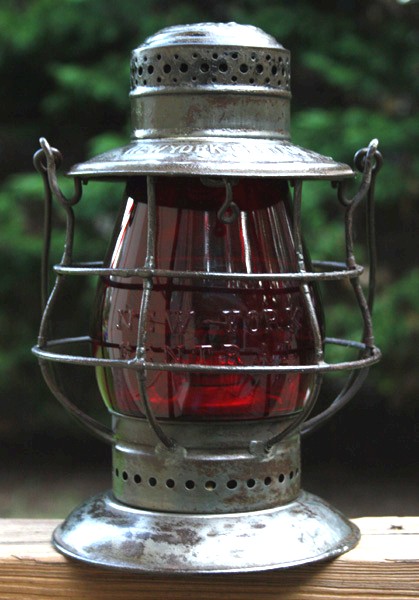
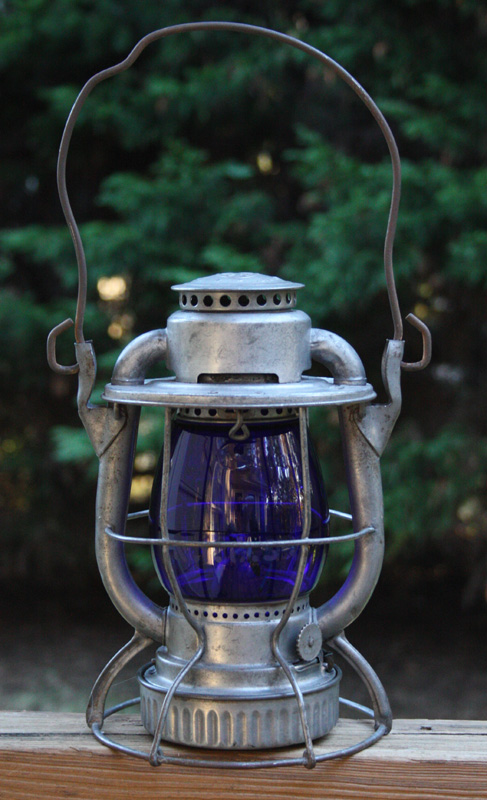
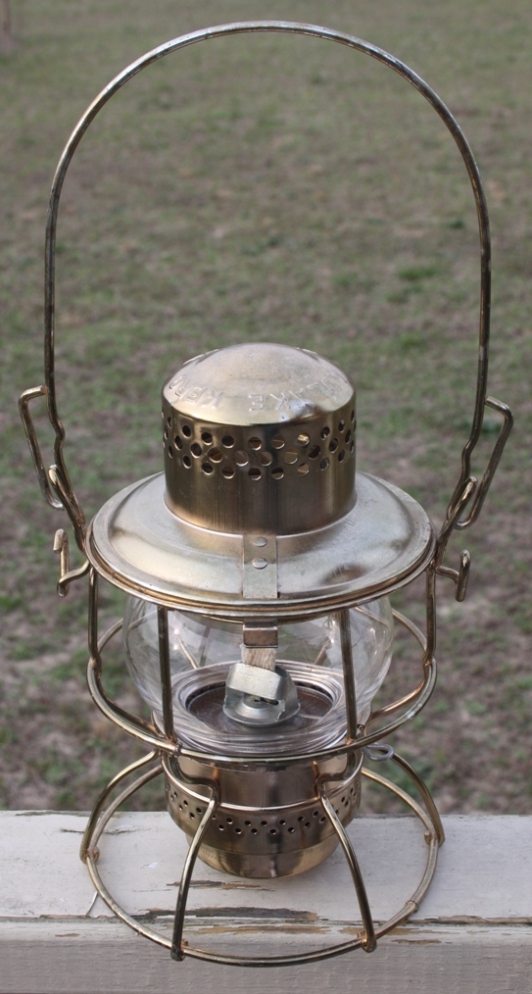
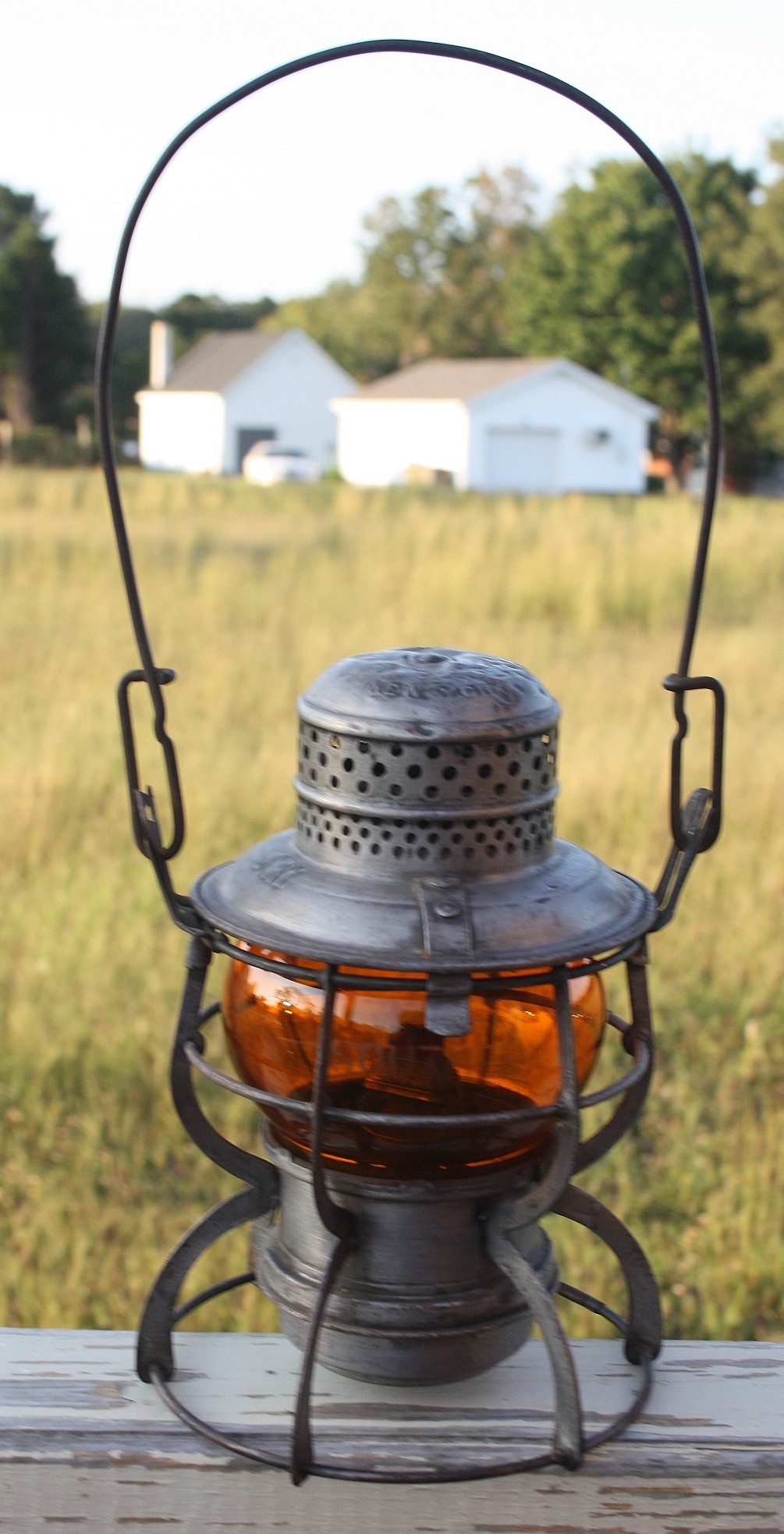
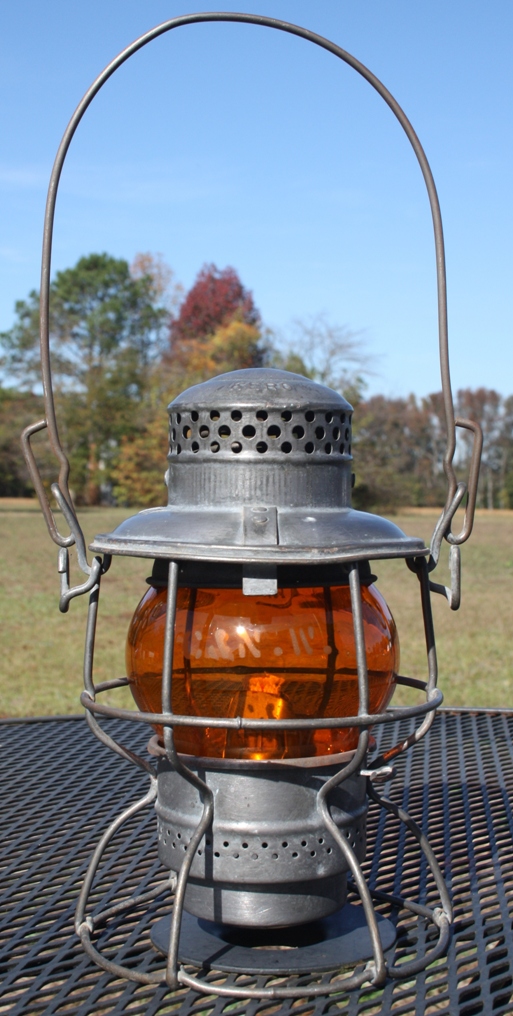
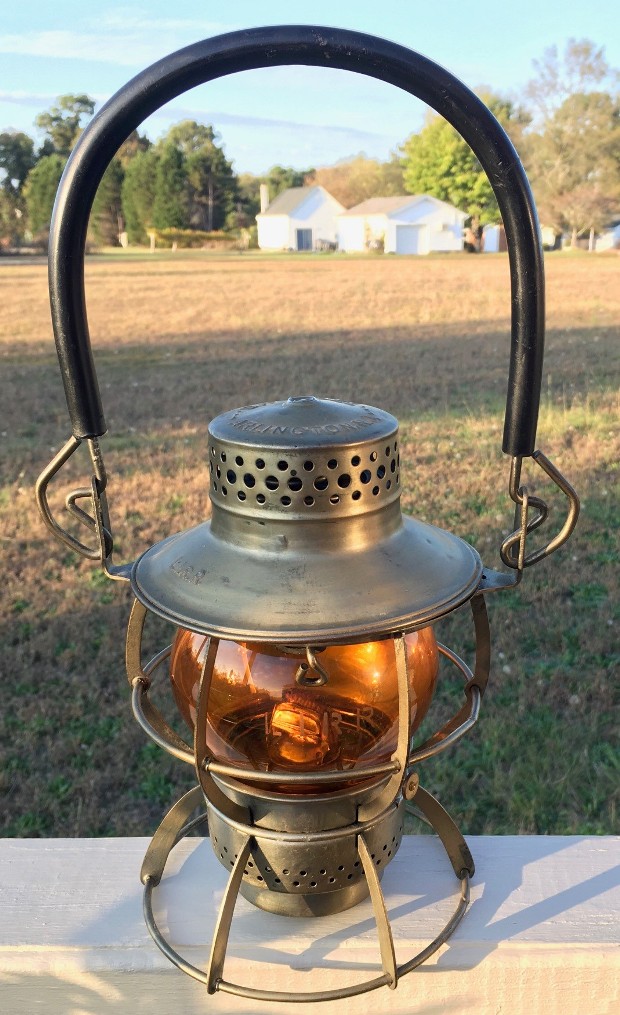
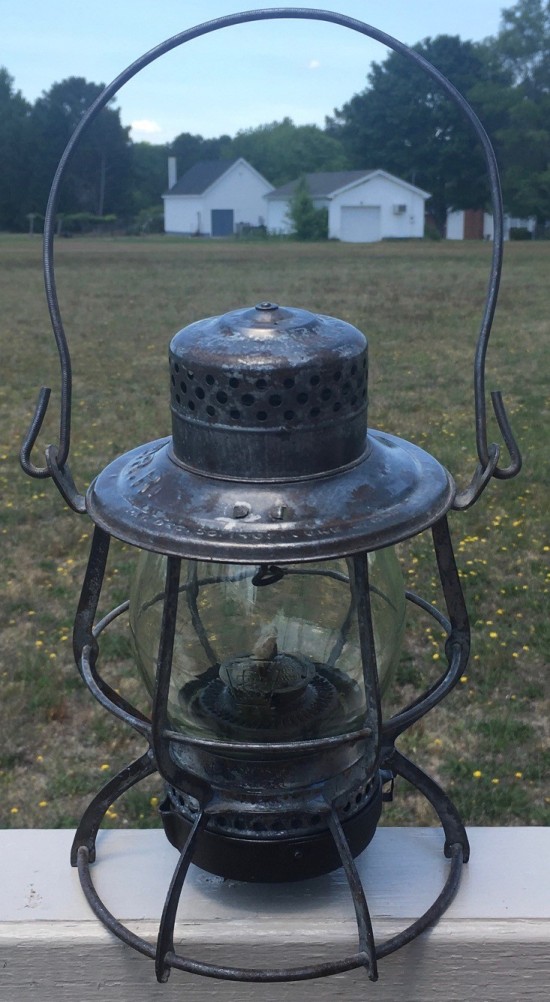
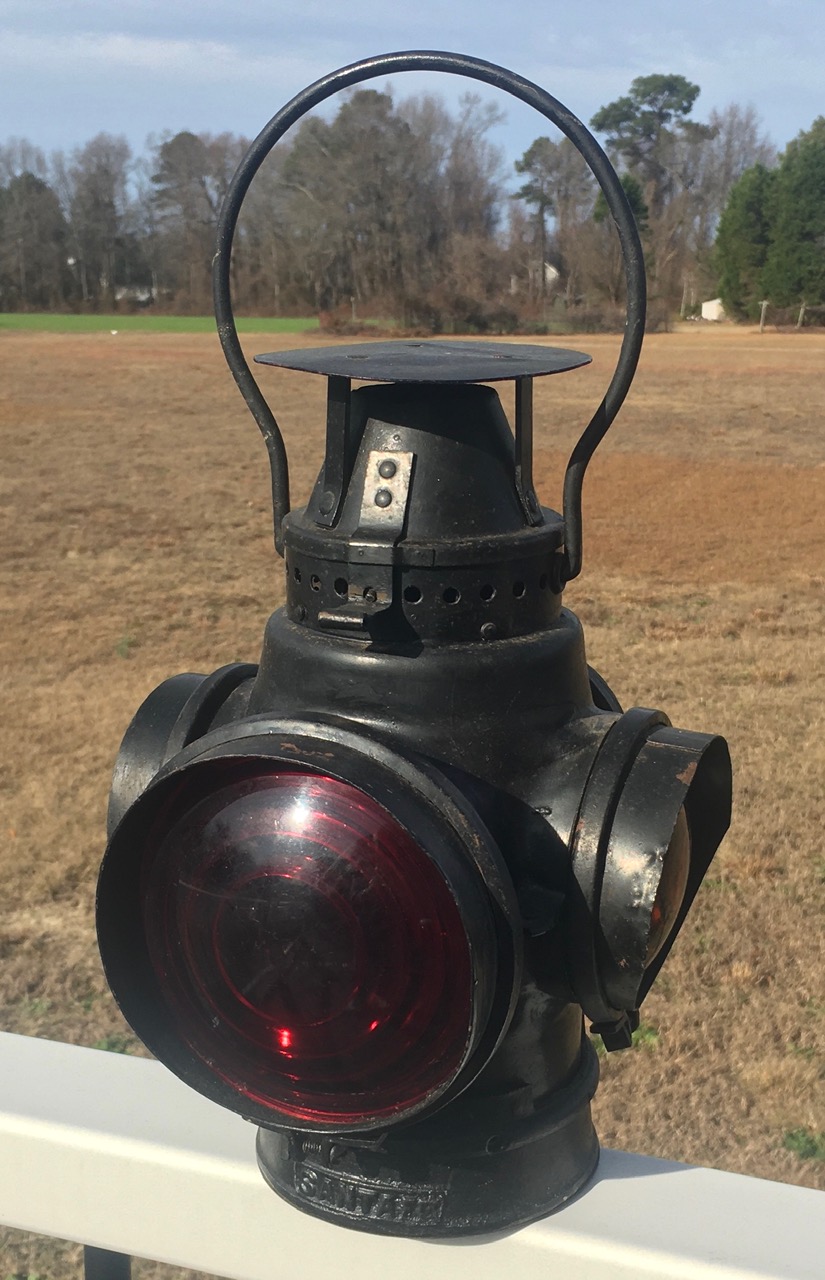
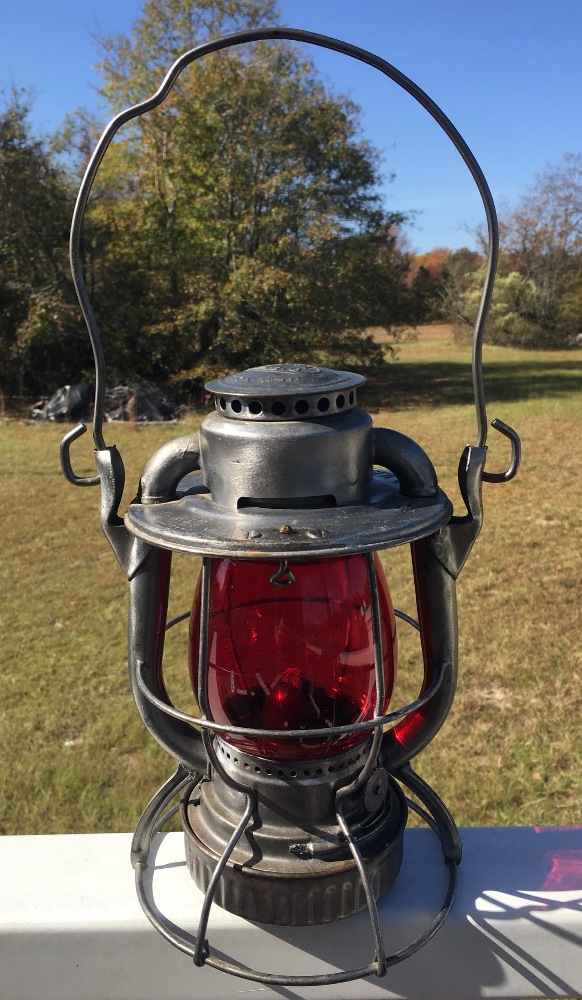
Below is a more detailed look at each lantern in my collection. Click on an image to see a larger picture, more pictures of the lantern, and some information about the associated railroad.
|
|
|
|
| Armspear lantern for Erie Railroad. Clear globe. | Hiram Piper lantern for Canadian Pacific Railroad (CPR). Amber/yellow globe. | Dietz lantern for New Haven Railroad (N.Y.N.H. & H.) Clear globe. | Adlake lantern for Penn Central Railroad. Blue globe. |
|
|
|
|
| Dietz lantern for New York Central Railroad (N.Y.C.S.). Red globe. | Dressel lantern for Pennsylvania Railroad. Red globe. | Adlake lantern for Southern Railway (SOU RY). Clear globe. | Adlake switch lamp. |
|
|
|
|
| Dietz lantern for Reading Railroad (RDG Co). Red globe. | Dressel crossing gate lamp. | Adlake lantern for Baltimore & Ohio Railroad (B.&O. R.R.). Blue globe. | Dietz #39 lantern. Red globe. |
|
|
|
|
| Dietz #6 lantern for New York Central Railroad. Clear globe. | Dressel switch lamp for Maine Central Railroad. | Dietz lantern for New York Central Railroad (N.Y.C.S.). Signal green globe. | Dietz lantern for New Haven Railroad (N.Y.N.H. & H.). Red globe. |
|
|
|
|
| Dietz #6 lantern for New York Central Railroad (more detailed). Clear globe. | Dietz lantern for Maine Central Railroad . Signal green globe. | Dressel switch lamp for Wabash Railroad. | Adlake lantern. Various globe colors. |
|
|
|
|
| Dietz #6 lantern for Boston & Albany Railroad (B.&A. R.R.). Clear globe. | Dietz #6 lantern for New York Central Railroad. Red globe. | Adlake lantern for Pennsylvania Railroad (P.R.R.). Clear globe. | Adlake lantern for Southern Railway (SOU. RY). Signal green globe. |
|
|
|
|
| Dressel Stainless derail lamp | Dressel Stainless switch lamp, possibly for Maine Central Railroad | Handlan marker lamp | Adlake Reflex switch lamp |
|
|
|
|
|
| Adlake lantern for Norfolk & Western Railway (N&W. RY). Red globe. |
Adlake bellbottom switch lamp. |
Adlake lantern for Baltimore & Ohio Railroad (B.&O. R.R). Clear globe. | Adlake lantern for Boston & Maine Railroad (B&M RR). Red globe. |
|
|
|
|
|
| Adlake bellbottom switch lamp for Union Pacific Railroad (UPRR). | Adlake bellbottom lantern for Grand Trunk Railway (GTR). Clear globe. | Handlan lantern for New York Central Railroad (NYCL). Red globe. | Dietz lantern for Reading Railroad (R. Co.). Amber/yellow globe. |
|
|
|
|
|
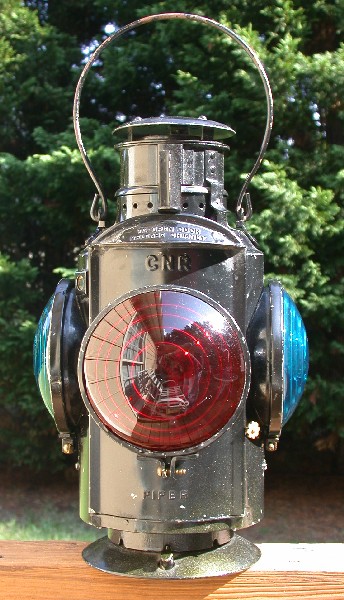
| Adlake lantern for Delaware & Hudson Railroad (D.&H. Co.). Clear globe. | Armspear lantern for the Louisville & Nashville Railroad (L.&N. R.R.). Red globe. | Vesta lantern for Boston & Maine Railroad. Amber/yellow globe. | Hiram L. Piper marker lamp for Canadian National Railways (CNR). |
|
|
|
|
|
|
Vesta lantern for Pittsburg & Lake Erie Railroad (P.&L.E. R.R.). Red globe. |
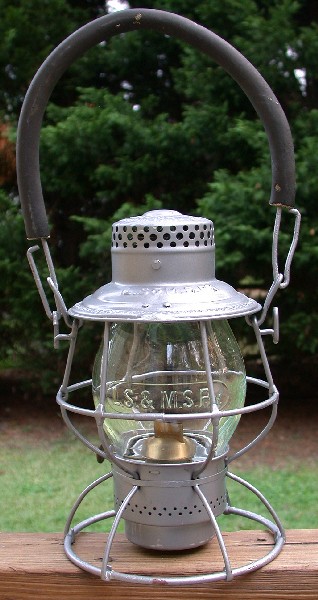
Adlake lantern for Lake Shore & Michigan Southern Railway (L.S & M.S. Ry). Clear globe. |
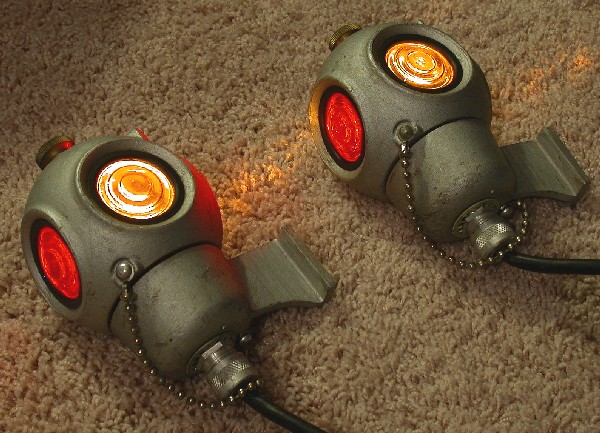
Pyle marker lamps (small style) |
Adlake lantern for Norfolk & Western Railway (N&W). Clear globe. |
|
|
|
|
|
|
Armspear lantern for the Erie railroad. Clear globe. |
JeffPo's Franken-Lamp |
Handlan "slow order" lamp for the Union Pacific Railroad (UP RR). |
Dietz #6 lantern for Empire State Railroad (E.S.R. Co.). Red globe. |
|
|
|
|
|
|
Casey lantern for the Atlantic Coast Line Railroad (A.C.L.). Red globe. |
Adams & Westlake lanterns for the Atlantic Coast Line Railroad (A.C.L. R.R.). Clear globes. |
Dressel crossing gate lamp |
Dressel train order lamps
|
|
|
|
|
|
|
Adlake lantern for Baltimore & Ohio Railroad (B&O. R.R.). Clear globe. |
Adlake lantern, possibly for Southern Railway. Various globe colors |
Dietz #6 lantern for New York Central Railroad. Red globe. |
Vesta lantern for New York Central Railroad (N.Y.C.S.). Blue globe. |
|
|
|
|
|
|
Star inspector lantern for New York Central Railroad (NYC-S). |
Handlan lantern for Pennsylvania Railroad. Amber/yellow globe. |
Handlan "slow order" resume speed lamp for the Union Pacific Railroad (UPRR) | Handlan steam engine tender lamp |
|
|
|
|
|
|
Adlake marker lamp for the Indiana Harbor Belt Railroad (I.H.B. R.R.). |
Dressel lantern for Central Railroad of New Jersey (C.R.R. of N.J.).. Red globe. |
Pyle marker lamps (large style) |
Handlan crossing gate lamp |
 |
|
|
 |
| Dressel slow order train lamp |
Handlan lantern for Cleveland, Cincinnati, Chicago and St. Louis Railway (C.C.C. & ST. L. R.R.). Red globe. |
Adams & Westlake nickel plated conductor lantern for the Pullman Palace Car Company |
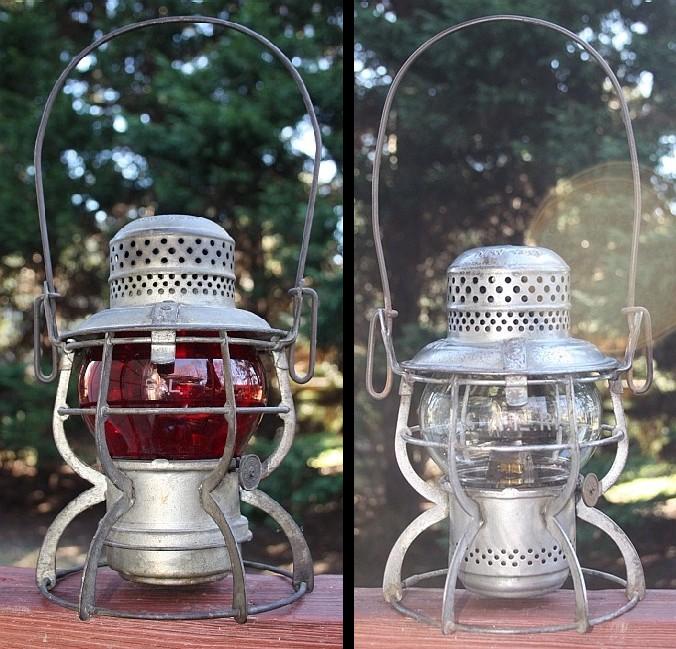
Adams & Westlake Franken-lantern for Northern Pacific Railway (N.P.R.R.)., |
 |
|
|
|
| Armspear lanterns for Seaboard Airline Railroad (S.A.L. RY.). Red and clear globes. |
Vesta lantern for New York Central Railroad (N.Y.C.S.). Amber/yellow globe. |
Dietz lantern for New Haven Railroad (N.Y. N.H. & H.). Signal green globe. |
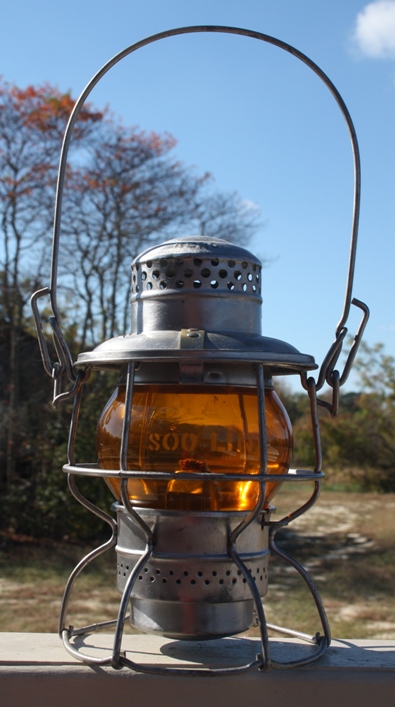
Adlake lantern for Soo Line Railroad. Amber/yellow globe. |
|
|
|
|
|
|
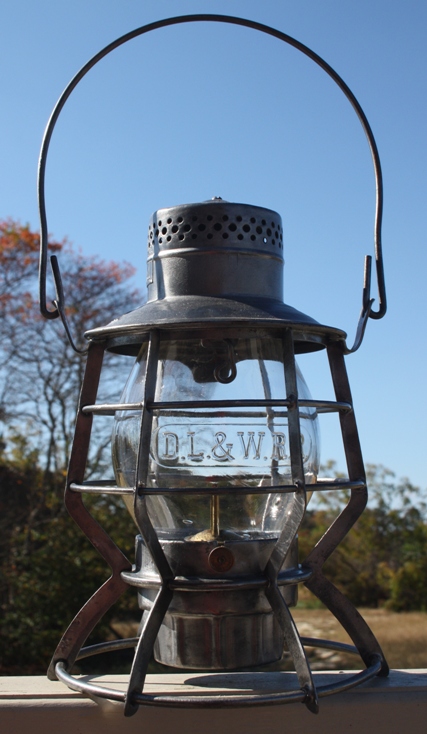
Dressel lantern for Delaware, Lackawanna & Western Railroad (D.L. & W. RR.). Clear globe. |
Aladdin caboose lamp |
Adlake lantern for Florida East Coast Railway (FEC. RY). Red globe. |
CT Ham conductor lantern (electrified) |
|
|
|
|
|
|
Adlake lantern for Nickel Plate Road Railroad (N.K.P.). Amber/yellow globe. |
Armspear lantern for Pennsylvania Railroad. Clear globe. |
Casey lantern for Baltimore & Ohio Railroad (B.&O. R.R.). Clear globe. |
Pyle National engine classification lamp |
|
|
|
|
|
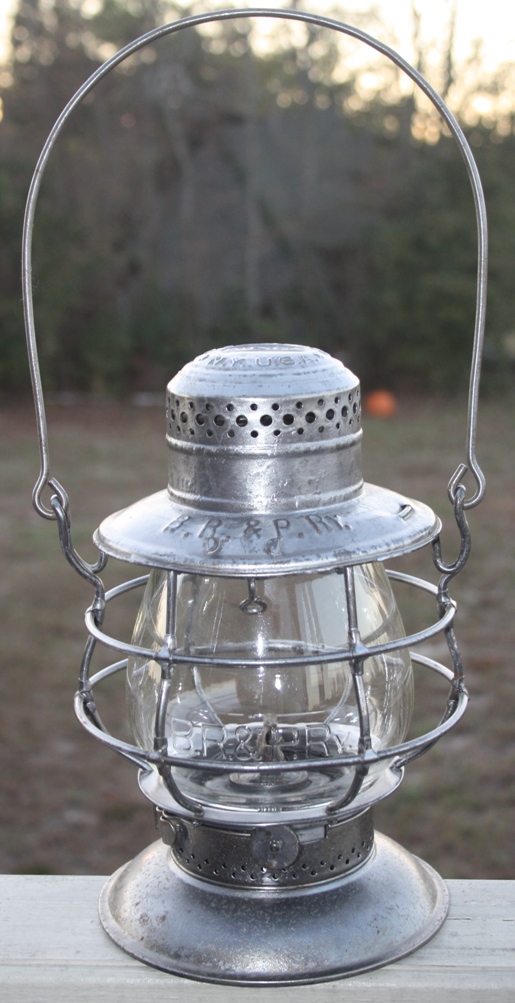
| Dietz #39 lantern for Buffalo, Rochester and Pittsburgh Railway (B.R.&P. Ry.). Clear globe. |
Adlake switch lamp. |
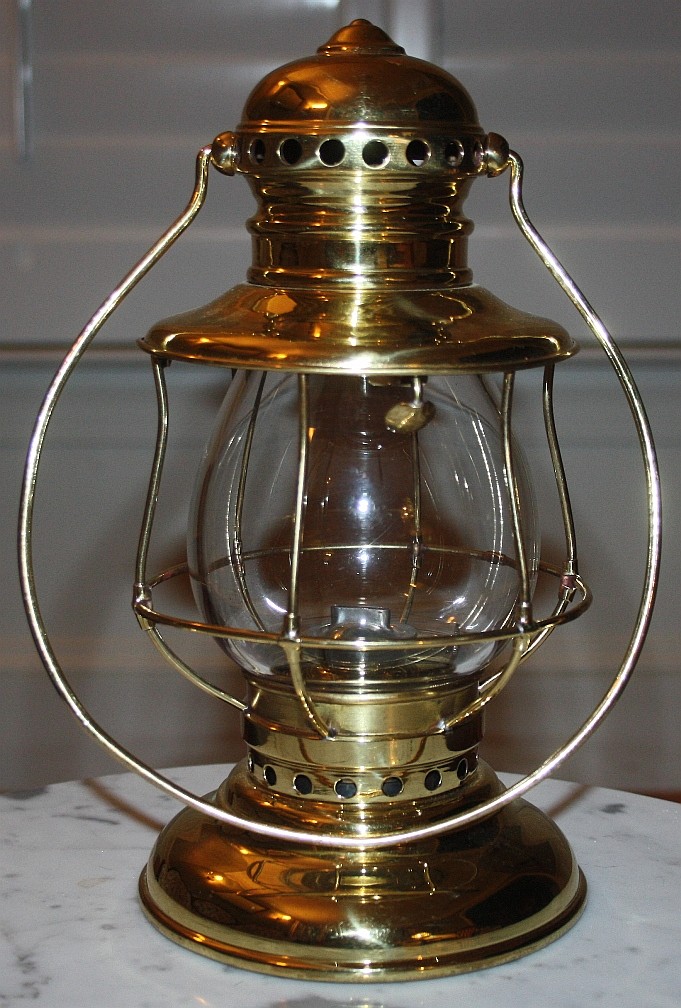
Adams & Westlake brass plated conductor lantern |
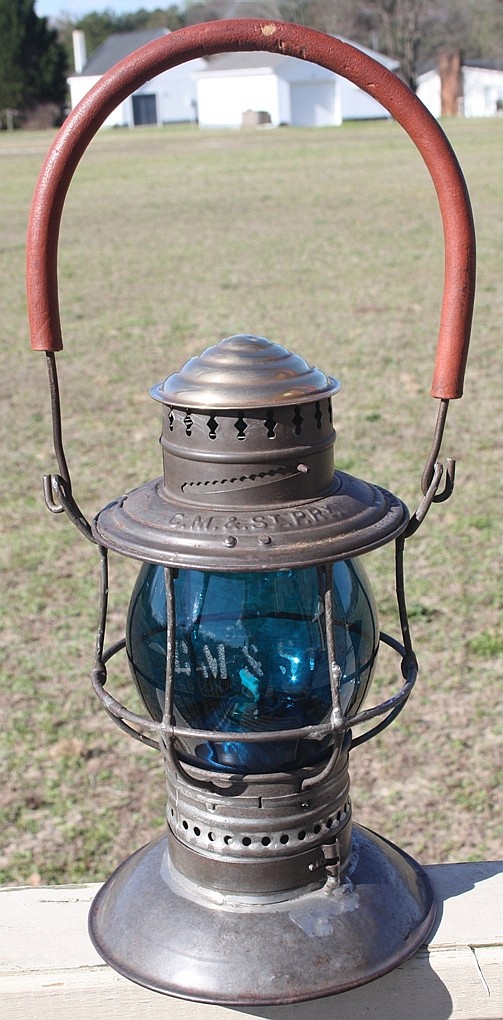
Adams & Westlake lantern for Chicago, Milwaukee & St. Paul Railroad (C.M.&.S.t.P. Ry.). Signal green globe. |
|
|
|
|
|
|
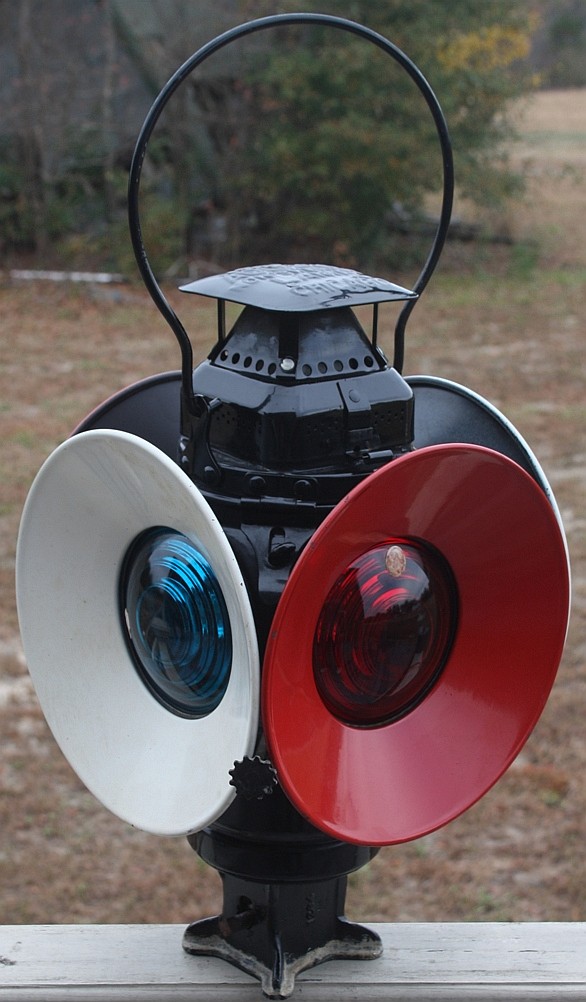
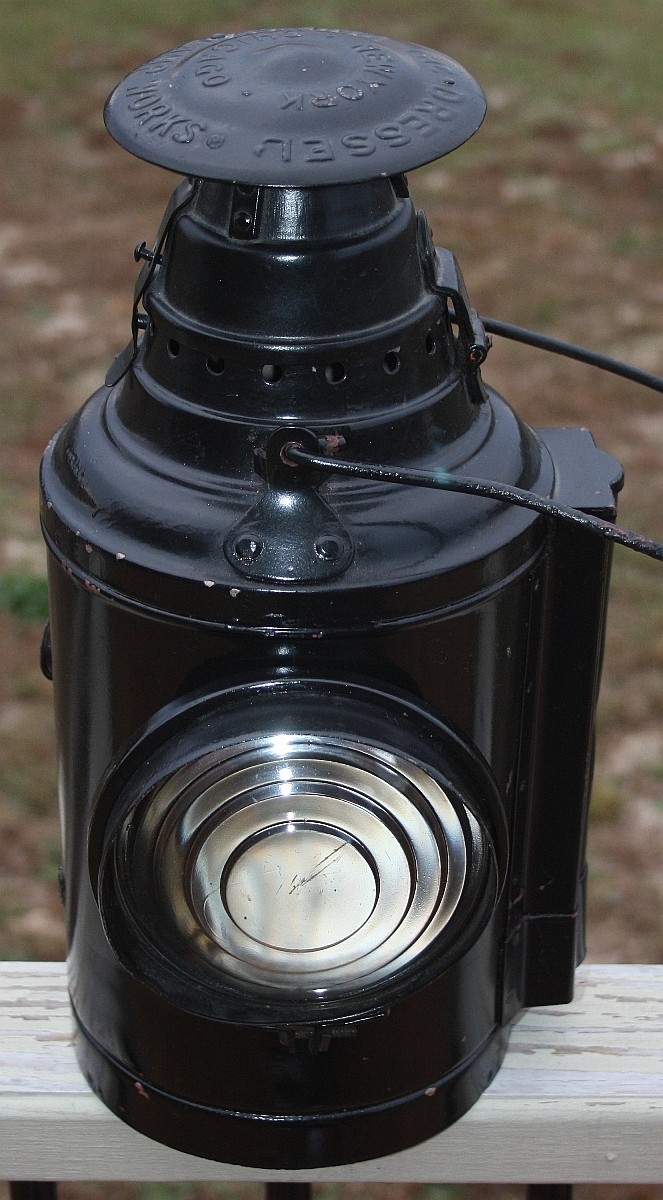
Dressel switch lamp |
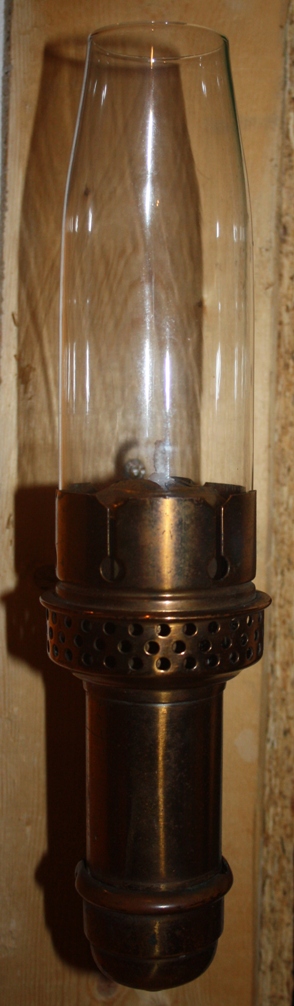
Brass RPO candle lamp |
Dressel semaphore lamp for the Pennsylvania Railroad (P.R.R. CO.) |
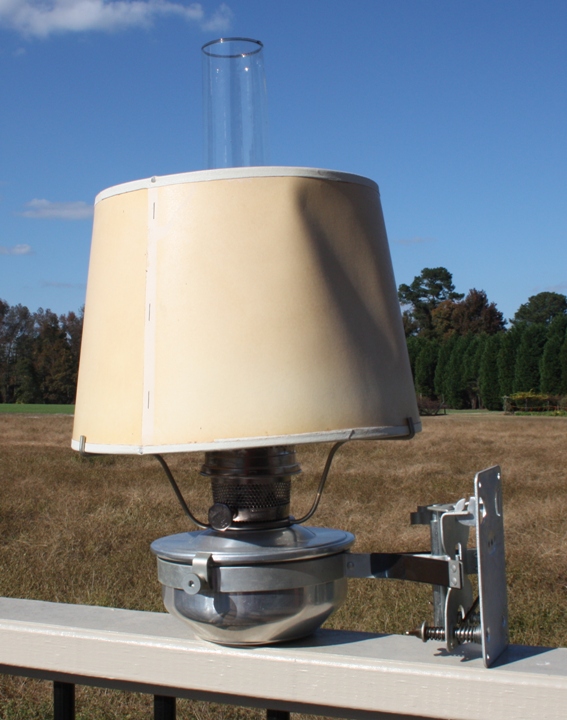
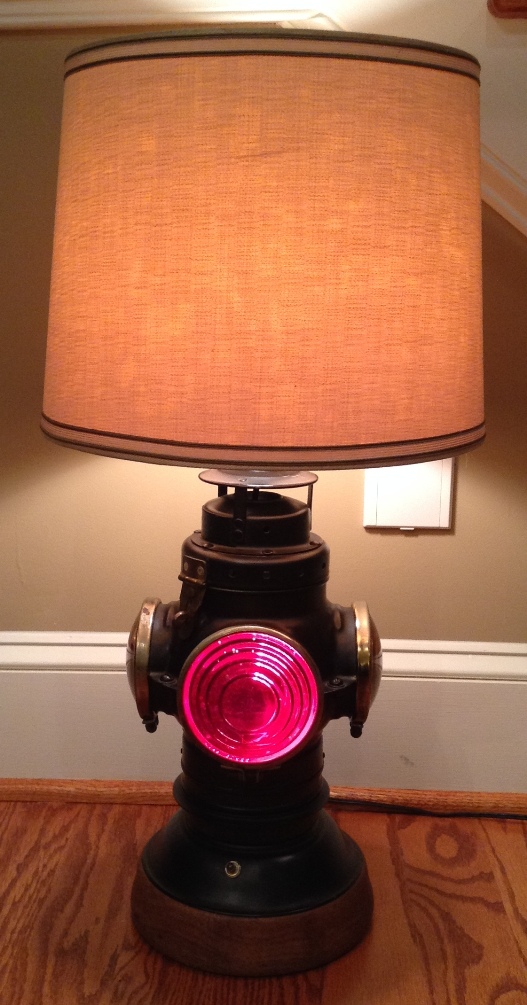
Armspear marker lamp (turned into a table lamp) |
|
|
|
|
|
|
Adlake Kero lantern, brass plated. Clear globe. |
Armspear lantern for Southern Railway (S. RY.). Amber/yellow globe. |
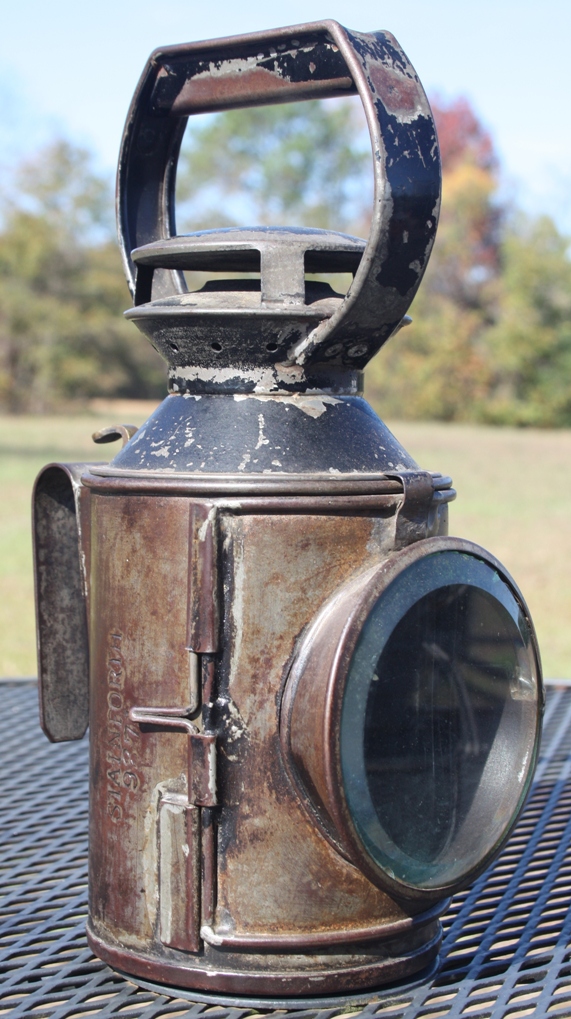
Tri-color (track walker) lamp for London and North Eastern Railway (LNE-C), a British railway. |
Adlake lantern for Chicago & North Western Railway (C.&N.W. RY). Amber/yellow globe. |
|
|
|
|
|
|
Adlake lantern for the Rock Island Railroad. Blue globe. |
Adlake "advance approach" lamp for the Union Pacific Railroad (U.P) |
Armspear lantern for the Great Northern Railway (G.N. RY.). Red globe. |
Adlake railway motor car lamp |
|
|
|
|
|
|
Dressel lantern for the Long Island Railroad (L.I.R.R.). Amber/yellow globe. |
Casey lantern for the Pennsylvania Railroad (P.R.R.). Clear globe. |
Adlake rear marker lamp for the Santa Fe Railway |
Dietz Vesta lantern for the Lehigh Valley Railroad. Red globe. |
|
|
|
|
|
|
Dietz #39 brass conductor lantern for the Illinois Central Railroad (ICRR) |
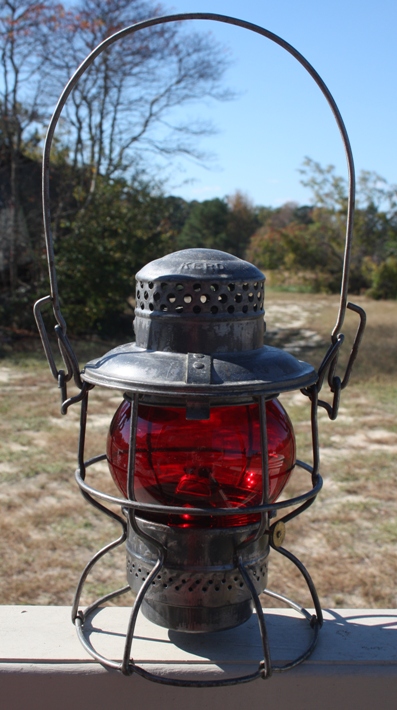
Dressel lantern for the Reading Railroad (Reading Co). Red globe. |
Adlake lantern for the Chicago and Eastern Illinois Railroad. Red globe. |
Who knows what I'll get next? |
NOTE: I don't do appraisals on a commercial or professional level. I only give my opinion of value of a lantern or two that a private individual might have come across, or inherited. If you have a number of lanterns that you're planning on selling, or auctioning, and need the values on them, you need to contact someone that is in the business of doing lantern appraisals. I don't have the expertise or ability to give values in these situations. I suggest you contact Sue Knous of Railroad Memories. She literally wrote the book on the subject.
NOTE: I mainly collect antique, obsolete, and kerosene powered lanterns and lamps. I don't know much about more modern electrical versions and thus can't help much with estimating a value on them, or even identifying them.
NOTE: http://www.railroadcollectibles.com Came across this webpage while surfing. They offer free appraisals. However, they do run auctions, so make sure their appraisal price is the true value, and not some low value just to get your lantern to sell for a big profit.
Disclaimer: while I collect lanterns and have a website, I'm still far from being an expert. There are no guarantees on the value of your lantern. I'm not doing an official appraisal. I don't do appraisals. I'm just giving you my personal opinion of what I think its value is, which the market could prove wrong. If you want an official appraisal of your lantern, there are companies that do that such as Railroad Memories.
The most common types of questions I get from visitors to my website are requests to identify the kind of lantern they have found, inherited, or purchased, followed by a request of how much is it worth.
For lantern identification and value, please tell me what is written on the top of the lantern, or along the brim of the top. I don't need patent dates, just the manufacturer name and the name or initials of the railroad if present. Tell me the color of the globe and any writings that may be on it. Let me know if the fuel fount/tank and burner is present. Lastly, send me an image or two. As they say, a picture worth a thousand words. But please don't send me gigantic, mega-megabyte files. Resize them if necessary into something that is easier to download.
Determining the value of a lantern can be quite difficult because it is so subjective. There are many factors that go into forming the value of a lantern. Age and condition are obvious. The older something is, and the better condition it is in, the more it is usually worth. With railroad lanterns, the road name on the lantern also matters. For example, the New York Central Railroad is a very common road name and the market has many of those types of lanterns, so they command a lower price than others. A Santa Fe lantern will usually be valued higher than a New York Central. A Virginian lantern seems to command higher prices. If the railroad is more obscure, or if items marked by that railroad are rarer, the pieces are valued more. Globe colors also factor into the value. Clear or red globes are more common. Blue and other colored globes are more rare. Lantern prices can range from around $25 into the thousands of dollars.
The types of lanterns also matter. Lanterns with brass tops, or conductor lanterns will command a higher price. The color of the globe will factor into how much it is worth. Clear and red globes are the most common, so they are lower priced. Blue, green, and amber globes are rarer, so they are generally higher priced. A globe that is marked for a particular railroad, with the railroad named etched or cast into the glass, will be more valuable than a globe that has no railroad name on it.
And of course, the market plays a big role, from who wants the lantern, to how bad they want the lantern, to where the lantern is being sold. If you find a lantern at a yard sale or flea market, you might buy it for a good price. Sometimes an auction can also net you a good deal. I buy the majority of my lanterns off of Ebay. It’s a hit or miss out there as to whether I get a good deal. Sometimes I do, and sometime someone else is willing to pay a lot more. Who wants a lantern can have an impact of what a lantern sells for. A person that deals and collects lanterns on a larger scale will not pay that much for a more common lantern. A novice or someone that has a casual interest might be willing to pay more. While it’s not an exact science given how each lantern is different, looking at the completed listings price on Ebay can sometimes at least give you a ballpark range of what a particular lantern might be worth.
Railroad shows and antique shops seem to have the highest prices. In general I can usually buy the same lantern I see at a Railroad show or antique shop for substantially less off of Ebay, especially if it's a more common lantern. The bonus of a railroad show is that you can look and examine the lantern directly, and the selection is pretty vast. I use Railroad shows to buy the more unique of items, and for parts, but save my purchases of more common stuff for Ebay. I also will not purchase stuff at top retail prices. I know I can always wait until a better deal comes along.
Lantern Evolution
Let’s briefly talk about the general types and the evolution of lanterns and lamps, so you can get a general feel for the values. There are about five basic types of railroad lanterns: fixed globe, tall globe, short globe, inspector, and conductor. There are a few other specialty lanterns, but these five are the main ones.
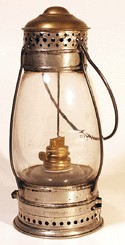
Fixed globe lanterns: Fixed globe lanterns represent the earliest of the lanterns, from a time around the mid-1800s. They are generally kind of slender. The globe is cemented/fastened in place, hence the term fixed globe. There's not much of a frame around the globe. Fixed globe lanterns are more rare, so their prices are higher, from about $500 on up, into the thousands of dollars.
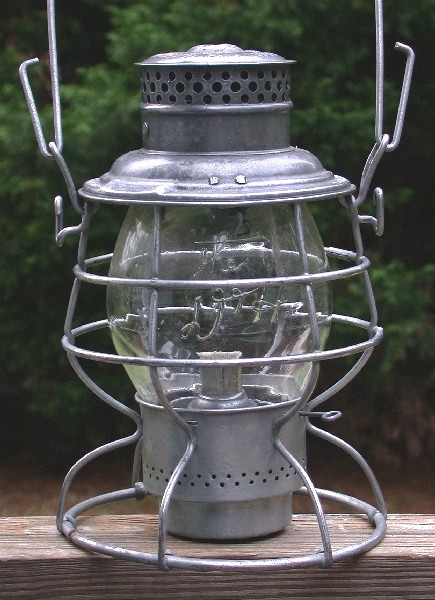
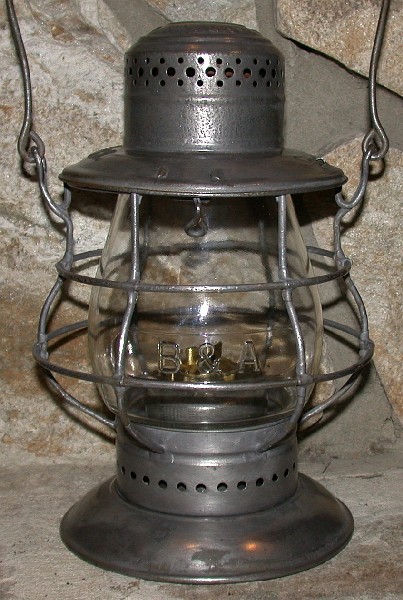
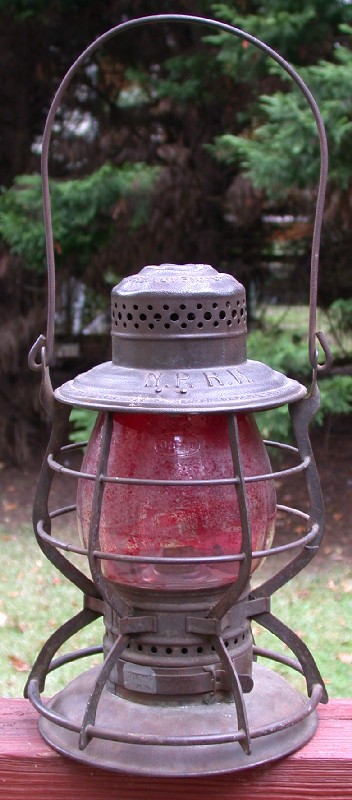
Tall globe lanterns: The tall globe lantern replaced the fixed globe lantern. It has a removable globe of 5 3/8” to 6” in height. It's also a bit more robust, with more frame around the globe to protect it. They were used from the last quarter of the 1800s up until the first quarter of the 1900s. In the images above, the lantern on the left has a wire base bottom. The lantern on the right has a bell bottom. Generally, the bell bottoms are a little older, and thus sometimes more valuable. The value on the more common models range from about $75 to $125. Rare models, especially with the more rare globes, can reach into the thousands of dollars. Brass top lanterns, so called because their top is made of brass, is a subset of tall globe lanterns that seem to command high prices of a few hundred dollars on up.
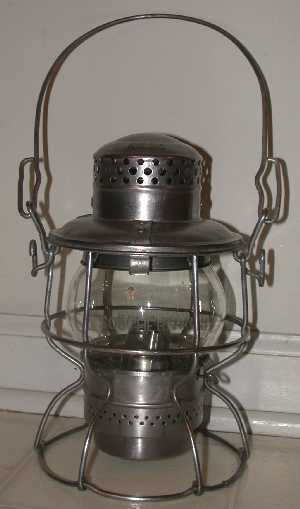
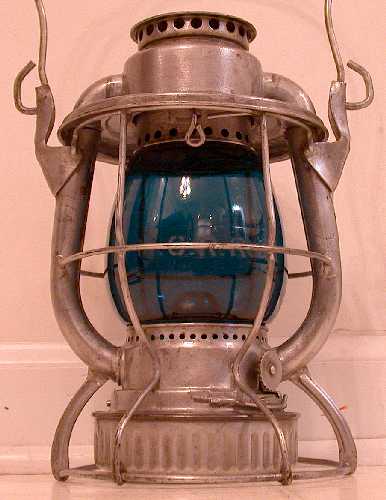
Short globe lanterns: The short globe lantern replaced the tall globe lantern. These came in toward the end of the first quarter of the 1900s and continued to be the dominant style until replaced entirely with electric lanterns, with the last of them being made in the early 1970s (though the Adlake company does still make them for collectors). Their globes ranged in size from about 3 ¼” to 4 ½”. In the images above, the lantern on the left is a standard short globe lantern, with a 3 ¼” globe. The image on the right is a Dietz Vesta lantern, with a 4 ½” globe. These burned kerosene, and were smaller and lighter than their taller predecessors (though the Dietz Vesta style was similar in size to the tall globes). Short globe lanterns are the most common, with values ranging from about $25 to $60. Those from more rare railroads, or those that have the more rare globes, can go from $100 to a few hundred.
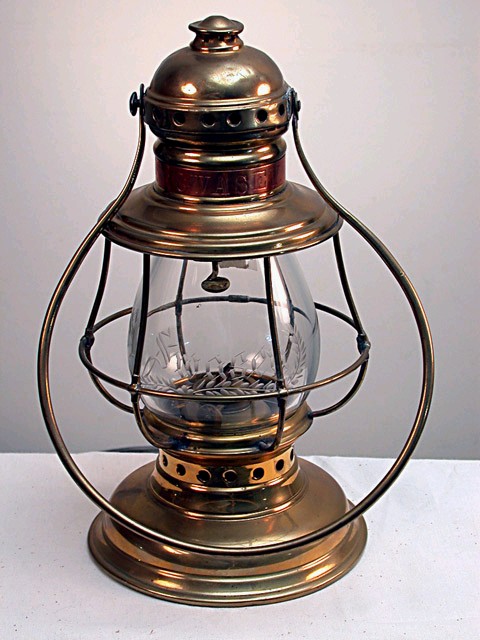
Conductor lanterns: The conductor lantern, sometimes called a presentation lantern, is a more ornate version of a tall globe lantern. They have curvy lines and are generally nickel plated or brass plated. The globes can sometimes be decorated with etched leaves and fancy letters, or have two colors. The conductor was the face seen by the paying passengers so he needed a lantern to show his status and to demonstrate the elegance of railroad travel. Values on the common models can range from about $200 to around $450. More rare models and globes can be from $1200 to $2000.

Inspector lanterns: Inspector lanterns were basically glorified barn lanterns. They are utility lanterns with a hood and concave mirror reflector. As the name implies, they were used to inspect the railroad cars and equipment at night. Values on these are generally around $70 or so dollars, give or take. One that is marked for the railroad on the handle might push closer to $100, and one with a railroad marked globe might be $125 or higher.

Lamps: You’ll also encounter the larger railroad lamps, such as the switch lamp or marker/caboose lamp. Average price on these might range from about $75 to $150, depending on what it is. More rare models, especially if they’re marked for the railroad, might garner a little more. Electric models are generally less valuable than fuel oil models. Square shaped bodies are generally a sign it’s an older lamp. However, a square top on a round body is generally a newer lamp.
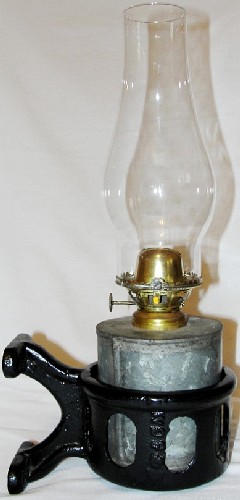
Depot, train car lanterns & lamps: The railroad also used a variety of lanterns and lamps in the railroad depots/stations, and in the railcars (passenger and caboose). Unfortunately, I don't know a thing about them. I haven't collected them nor have I found a good book to use as a source. If you're looking for information about this category of lanterns and lamps, I'll direct you to the Q&A section of http://www.railroadiana.org/pgQB.php.
If you contact me for the value of a lantern I’ll do my best to describe what I think the potential is, from the lowest to the highest. Just realize it’s hard to pin an exact dollar amount to a particular lantern, and this is only my personal opinion, which is subjective and could be wrong.
Disclaimer: This bears repeating ... while I collect lanterns and have a website, I'm still far from being an expert. There are no guarantees on the value of your lantern. I'm not doing an official appraisal. I don't do appraisals. I'm just giving you my personal opinion of what I think its value is, which the market could prove wrong. If you want an official appraisal of your lantern, there are companies that do that such as Railroad Memories.
If you email me and don't hear back within a few days, I'm not purposely ignoring you. I'm pretty busy and I get lots of email so sometimes I miss something, or if I don't respond right away it will drop off the main page and I'll forget about it. Feel free to send a secondary email, or even a third if you haven't heard back from me within a reasonable amount of time. I answer all emails.
NOTE: Feel free to change the subject line from "Inquiry from Lantern webpage" if desired.
Want to sell your lantern to me?
A lot of people that contact me for the identity and value of a lantern also want to know if I'm interested in purchasing it. I'll always have some sort of interest, if it's in decent shape, but the level of my interest will vary as to what it is, and how much I want (or need) it. I am not a high end collector, so I won't pay dealer or railroad show prices. I also won't pay antique shop prices. The prices I'm willing to pay will be more in line with the better deals I find on Ebay. I won't try to steal the lantern from you, and my offer will usually be better than wholesale (i.e. what a dealer would try to buy it for). I'm always up front and honest about what I offer, what I'm basing it on, and I'll tell you if I think you can get more. I won't try to trick you into selling it to me. I base my offers on what the item is worth to me (which can be quite subjective), what I've paid in the past for similar items, and what I think I can buy it for somewhere else.
For example, if you present a plain Southern Railroad Adlake lantern, or a New York Central Railroad Vesta lantern, or a Pennsylvania Railroad Dressel lantern for sale, I'll probably offer you about $25 (if I'm in the market to buy one). The reason is that these are very common lanterns, I already have versions of them, and I can buy them for that elsewhere. That's probably better than a wholesale price, but honestly, if money is what you're after, you can probably (though not guaranteed) get a little more for it on Ebay. Rest assured that I 'm not trying to buy lanterns to make a profit. I fuel them up and use them personally. When they come to my collection they stay. The only exception is when I give a lantern as a gift to someone.
Occasionally someone offers something that is unique and that I really want. I of course offer more for it.
Just remember that I'm offering what the item is personally worth to me. I'll still tell you my personal opinion of what I think the value is, whether or not I buy it. I know some people have turned selling and buying railroad lanterns into a business, but it's still just a passionate hobby to me. I only buy for my enjoyment (not for resale) and I don't charge for advice. And I also try to share each lantern I purchase with the world via this webpage so that others can learn about them.
NOTE: if you jumped straight to this section from the top I encourage you to read the other sections on this page about how lanterns were used, their value as a collectible, and visit the variety of lanterns I have in my collection.
NOTE: Feel free to change the subject line from "Inquiry from Lantern webpage" if desired.
Restoring and cleaning lanterns
If you’ve ever watched the Antiques Roadshow or similar program, you’ve probably seen an appraisal of a piece of furniture go like this:
Appraiser: “You’ve got a lovely piece here that is in excellent condition.”
Owner: “Thanks. What’s it worth?”
Appraiser: “It would easily bring $2500 at auction.”
Owner: “Wow! I didn’t realize it was worth that much.”
Appraiser: “And if you had not refinished it, it would bring one million dollars!”
I’m exaggerating, but that seems to be the theme. Leave furniture the way it is if you want to maintain its value. Thankfully that is not the case with railroad lanterns. I’ve been watching auctions and sales for years and the cleaned and restored lanterns are the ones that go for more money. So if you have an old lantern don’t hesitate to clean it up, remove the rust, or even repaint it in case of switch lamps if that's what you want to do. It won't hurt the value. The only exception might be the really old stuff like those older, fixed globe lanterns, or lanterns that had a japanned coating. I'd also be a little cautious with conductor style lanterns (i.e. the nickel or brass plated ones). All that said, there are some that like to leave things in their original condition, with the old paint and such. That's understandable. I don't always clean and repaint my lamps.
Fine steel wool and brillo pads do wonders in cleaning up your basic dirty lantern (but NOT nickel or brass plated conductor lanterns). Some people are experts at removing rust. I’m not, so if the brillo pad doesn’t do it, that’s as far as I can go. But others use lye, bead blasting, etc. to get a lantern looking like new. You do have to know what you're doing if you're using the more harsh methods like bead blasting. You could damage the lantern or remove too much metal. Lanterns were tin coated from the factory, so if you remove too much of that it makes them more prone to rust.
You can also protect a lantern by applying an enamel clear coat to it if you don’t plan on using it. I’ve done that to a few, but now I mostly just wipe them down with a cloth and machine oil. I have found that some of the extra clean lanterns I've purchased have a tendency to rust. Probably because the protected tin coating has been removed. So in the future I'll probably put an enamel clear coat on them. On a few of my lamps (i.e. not lanterns) I’ve used Rustoleum enamel spray paint to give them a fresh coat. In regards to paint, I've been asked whether someone should use gloss, semi-gloss, or flat finish. The answer is "yes". In other words, use whatever looks good to you. When in doubt, use a semi-gloss finish, which is my preferred finish. I think semi-gloss is probably the most popular. However, I also have lamps that are painted with a gloss finish, and some with a flat finish. Use what you like.
Disclaimer: you clean your lanterns at your own risk. The purpose of this website is for general advice based on my subjective opinion, and to tell you what I do with my lanterns. I make no guarantees how cleaning your lantern will affect the value, positively or negatively.
Using a railroad lantern around the house
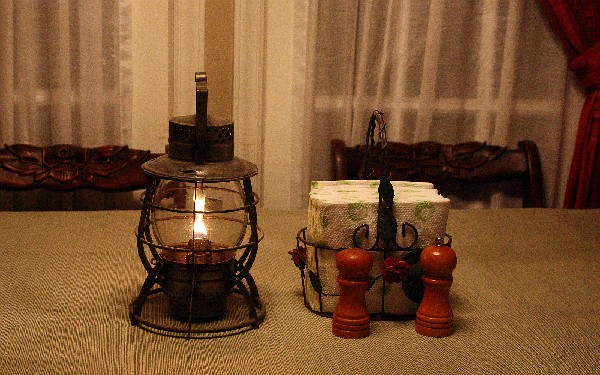
Dietz "Steel Clad" utility lantern sitting on my dining table.
I encourage everyone to fire up their lantern. They make great mood lighting and can be used as a centerpiece on the table during the evening meal. Are you sitting on the deck and enjoying the summer night while you count lightning bugs? Why not accent the setting with a railroad lantern with a red globe? I sometimes light more than one. I might use the clear globe or I might add a little color by using a red or green globe. Your lantern can also be used for auxiliary lighting during power outages, or at the campsite. I always take mine along during camping trips. And you never know when a train might come by and you'll need it! :) Some folks have asked me what is the best fuel to use in their railroad lantern. They were made to burn on kerosene, so the best fuel is fresh kerosene.
However, some people don't like the odor of kerosene. And kerosene can be a bit of a hassle to buy and store, given you probably have to get it from a gas station that sells it (if you can find a convenient one). Another fuel possibility, and the one I use is ordinary lamp oil from a place like Walmart. My wife complained about the scent of kerosene so I started using the lamp oil. Lamp oil still has a scent, but it's not as strong as kerosene. I'm currently using the Lamplight Medallion brand.
There is a product called Ultra Pure Lamp Oil, which is paraffin based. I'm not recommending it because I've heard of complaints that it doesn't wick properly, or burns erratically. While it burns with even less odor than the ordinary lamp oil, it's really made for candle oil lamps, with round wicks of 1/4" or less, or for use with flat wicks of 1/2" or less. I’ve heard that once you’ve used a wick with paraffin based oil, you can’t go back to using it with kerosene or lamp oil because of the paraffin content now in the wick. Don’t know how true that is, but you might want to have some extra wicks on hand if you’re experimenting with it. I will say that when I first stopped using kerosene, I actually did use paraffin oil for a while with no ill effects. Didn't burn as bright as kerosene, but seemed to work. But I only use regular lamp oil now. It's cheaper, readily available, and probably the better product to use with my lanterns.
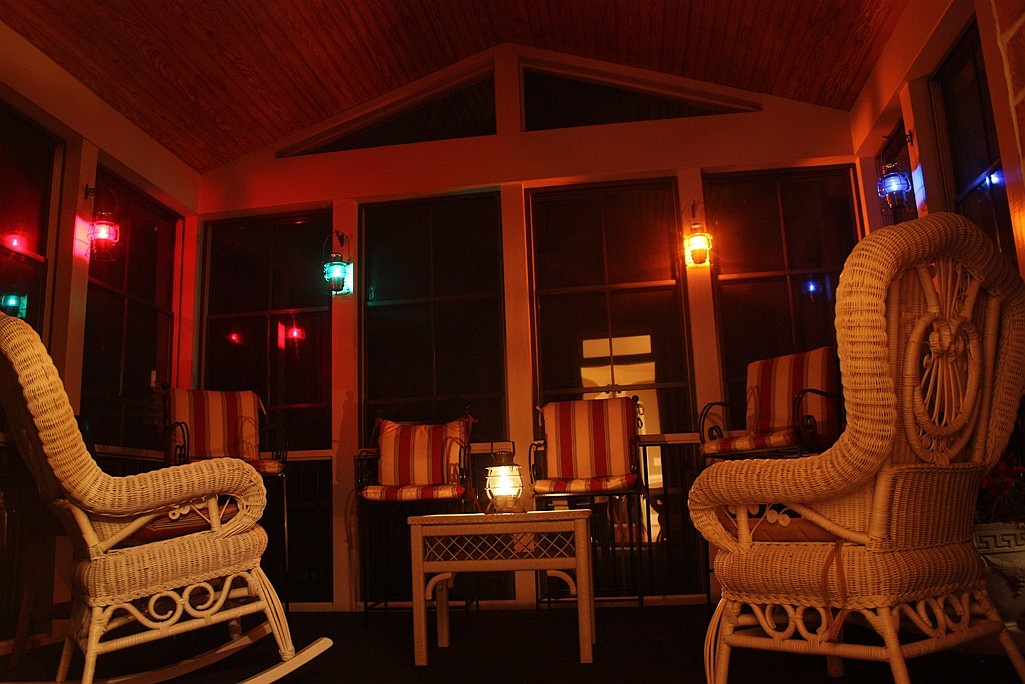
Various Adlake lanterns with various color globes in my three season room.
Other Railroad Related Pages On My Site
Railroad Lanterns (current webpage)
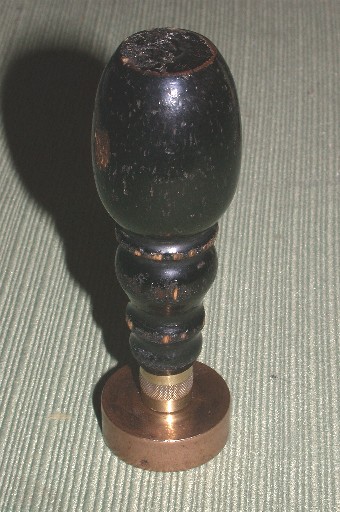 Wax sealers, telegraph, whistle, misc.
Railroad Lantern Resource and Information
Parts, Supplies, & Lanterns
LanternExpress1 Ebay seller Jack Moore sells a variety of lanterns and parts.
http://www.rubylane.com/shop/timestreasures Time’s Treasures This is a shop run by Jane Silvernail. Not only do they have railroad items, but they have other collectibles too. I like how they not only describe the item, but also try to offer a history and how it was used. Take a visit and see if something interests you.
http://www.lanternnet.com W.T. Kirkman Oil & Electric Lanterns. Good information on lanterns, some history, etc. Some info on cleaning lanterns. They also sell a nice selection of new lanterns, even a "railroad style" version. They also sell lantern parts.
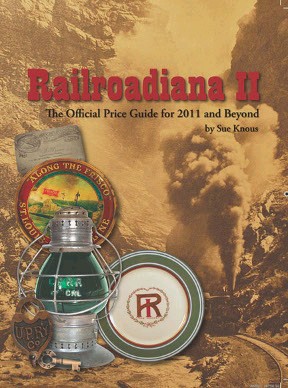
http://railroadmemories.com Railroad Memories. Run by Sue Knous. Auction site for railroad stuff. Looks like a well run auction. Satisfaction and authenticity guaranteed. They also offer official appraisals. They also produce a very nice book that is a price guide on various railroad items. It's a great reference and research tool. Tell them I sent you.
Information & Learning
http://www.railroadiana.org Website of Railroadiana Online. It outlines about everything you'd ever want to know about lanterns and lamps from manufacturing details to restoration. Awesome site with awesome information. Lantern and globe surveys. Great Q&A forum that you can search, or post your own questions: http://www.railroadiana.org/pgQB.php If you only want to consult one railroad lantern site, this is probably it. It also has info on other railroad items. While they'll answer technical questions when they can, they don't give values on lanterns.
https://www.facebook.com/groups/RailroadLanterns Railroad And Railway Lantern Collectors Facebook group for railroad lantern collectors. This is an excellent and very active group with a huge knowledge base. You'll find some true experts out there and it's a great resource for everything about railroad lanterns. These guys are great for answering questions about lanterns, from age, to rarity, to value. You'll find some true experts there.
http://www.railroadsignals.us Railroad Signals of the US. Excellent webpage by Todd Sestero. Great site with lots of images covering the various railroad signals used by American railroads.
http://www.railroadsignals.us/basics/basics1.htm Understanding American Railroad Signals. This is a direction link to the subject on Todd Sestero's webpage.
http://www.tagtown.net/tagtown.html Tag Town. Great website about railroad baggage tags. It's good for learning and to use as a resource.
http://madisonrails.railfan.net Roger Hensley's Railroads of Madison County. Photos, information, and stories about railroading in that region. Check out the articles on the Memory Pages. Contributor Maurice Lewman has given me great information on lantern signals.
http://antique-padlocks.com/rr.htm Antique Padlocks. Website devoted to preserving the history of padlocks. Lots of pictures. This link goes to the railroad locks section, but many other types of locks are out there if you're interested.
http://www.therailroadpolice.com The Railroad Police. Website about the railroad police from various railroads with lots of historical photos, including badge images.
http://www.gserr.com Golden Spike Enterprises. Lists some of the bigger trains shows (like Gaithersburg) and events on the east coast. They also have an auction, but they charge you for the catalog. I could see charging for a hardcopy listing for the auction to cover printing costs, but they should provide a free online version. I think they would have a better response. I've decided I'm not going to pay to just participate in an auction.
The Rest of the Stuff
http://www.railroadcollectors.org Railroadiana Collectors Association. Founded in 1971, RCAI promotes fellowship and scholarship among collectors of the artifacts of railroad history. General information along with stuff on cleaning/restoring lanterns, as well as info on fake and reproduction lanterns/globes.
http://www.railroadcollectibles.com/ Railroad Collectibles Came across this webpage while surfing. They claim they buy railroad items and also offer free appraisals. HOWEVER, this person runs auctions, so instead of buying for collecting, they are probably buying to resale in their auction. If their appraisal price is close to their offer to buy, I'd be cautious as they might be undervaluing your lanterns. No experience whatsoever with this person, so I don't know how they do business. This is just a word of advice, which would be applicable to any person in the buying and selling business.
http://www.railserve.com Website of RailServe.com. It's a railroad oriented website that has links to tons of railroad oriented sites, from antiques, to jobs, to operating railroads.
http://www.klnl.org Key, Lock & Lantern, Inc. Key Lock & Lantern is a non-profit organization dedicated to the preservation of railroad memorabilia and history. Members receive a quarterly magazine about railroad history & railroadiana collecting, a bi-monthly e-mail newsletter, and an invitation to participate in an annual convention. They have lantern survey information.
http://www.railroadcollectors.org Railroad Collectors Association Incorporated (RCAI). Another organization that promotes fellowship and scholarship among collectors of the artifacts of railroad history.
http://www.collectorsweekly.com/railroadiana/overview The Collectors Weekly. A way to look for your favorite items on Ebay. This link is for railroad stuff.
Railroad Places To Visit
North Carolina Transportation Museum 411 S. Salisbury Ave., Spencer, NC 28159. Phone: 704-636-2889. Neat museum with a lot of railroad items. You can ride the trains too, though it's only back and forth (not a loop).
Tweetsie Railroad 300 Tweetsie Railroad Lane, Blowing Rock, NC 28605. Phone: 800-526-5740. Old west train theme park. Pretty much an amusement park in the mountains, with a train running around the mountain. Very neat.
Wilmington Railroad Museum 505 Nutt Street, Wilmington, NC 28401. Phone: (910)763-2634. Nice collection of railroad items in historic Wilmington, NC.
Great Smoky Mountain Railroad 45 Mitchell Street, Bryson City, NC 28713. Phone: 800-872-4681. Dinner and adventure train. You can also combine it with local white water rafting.
New Hope Valley Railway 3900 Bonsal Rd. New Hill, NC 27562. Phone: (919) 362-5416. Small railroad museum that also offers train rides.
Frequently Asked Questions FAQ
Frequently asked questions I receive about antique railroad lanterns.
| Question | Answer |
| Do you sell lanterns? | No, I don’t. My lanterns are just my personal collection. |
| Do you sell lantern parts? | No, I don’t. |
| What’s my antique railroad lantern worth? | That depends. It depends on age, condition, railroad road name, rarity, globe color, etc. Look at my railroad lantern value section for more information. The most common short globe lanterns will be around $40 to $60, though flea market finds are in the $25 to $35 range. Common tall globe lanterns will be around $75 to $100. A common switch lamp will be in the $125 range. |
| What fuel should I use in my lantern? | Most were made to run on kerosene. If you don’t like the smell or inconvenience of buying/storing kerosene, use lamp oil. I use lamp oil from Walmart in mine. I'm currently using the Lamplight Medallion brand. |
| How do I clean my lantern? | I’m not an expert in this area. I lack the skills and patience. If you Google or yahoo the subject, you’ll find all kinds of stuff like lye baths, etc. Personally I do the best I can with Brillo pads (though not on brass or nickel plated conductor lanterns), and leave it at that. |
| What color should my lantern be painted? | For the most part, railroad lanterns were not painted. They were tin coated at the factory and the railroads used them that way. A painted lantern is generally a sign someone painted it after its railroad days. There is one lantern, a Dietz 999, that is factory blue. But don’t confuse lanterns with lamps, such as switch lamps. Switch lamps were painted. The colors I’ve seen is either black (most common) or yellow. I’ve painted a few of my lamps using both gloss and satin Rustoleum spray paint. They turned out great. I'm of the opinion that painting a common railroad lamp (i.e. not lantern) will not affect its value. Some might disagree with me on that, but I haven't seen common lamp prices be affected by a new coat of paint. I do see why some want to keep it original. Paint at your own risk. However I've found that painting your railroad lantern will negatively affect its value somewhat. |
| Do you buy lanterns or lantern collections? |
No. Well, maybe, kind of. Buying collections? No, I don’t have the funds for that. But every now and then I do buy a lantern from someone that contacts me if the price is right, and it’s something I want. I've also been given some lanterns because someone wanted a collector that appreciated it to have it. |
| Are you an antique railroad lantern appraiser? |
No, I’m not. Any values I give are just best guesses, on what I’ve observed. Nothing official about them. In fact, I could be totally wrong. I am far, far from an expert. I’m more familiar with common items. Rare items aren’t my expertise. The fact that I have a webpage just means I have a passion for collecting and sharing. |
| Do you appraise lantern collections? | No. I will give you what my opinion of value is for a single lantern or two if I have one. But if you’re a dealer or seller that’s looking for values on a lot of lanterns, or someone that’s trying to price an entire collection, I don’t provide those sorts of values. There are those that do offer that kind of service. Look at my links for those contacts. |
| Where can I get a railroad lantern? |
The easiest place is Ebay. If you’re just getting started, I suggest a common road name in a short globe lantern like the Adlake 300, or Dietz Vesta. Flea markets are another source, though sometimes the sellers think their common railroad lantern is super rare and thus super expensive. Antique shops often think they are made of gold. Just make sure you’re buying a real railroad lantern instead of a utility lantern that someone thinks is a railroad lantern. Look at my non-railroad lantern section for some common mislabeled lanterns. |
| Where should I sell my railroad lantern? | If you want to reach the largest audience the best venue is Ebay. Of course Ebay will charge you to list it there, and take a cut of your profits. But it’s still the easiest way to reach the collectors that want it. Craigslist is another option, but you have to be careful when dealing with people face to face. A lot of crazy folks out there, and scammers. And the collector pool is much more limited on Craigslist. I personally buy and sell things on Craigslist, but it's not for everyone. Likewise, some don't like dealing with Ebay because of the fees they charge. Another venue is the Market Place on FaceBook, though it's similar to Craigslist with regards to the audience. There are however, specific FaceBook pages dedicated to Railroadiana. |
| Can I advertise on your webpage? | Nope. One reason I maintain my own webpage and domain is that I don't like ads all over the place. I know I could make a little money on it, but this is a hobby that I have a passion for, so I'm not in it to make money. |
| Will you list a link to my website in your favorite links section? | Maybe. There are generally two reasons that I will list a website in my links section; 1) I like the site and/or consider it a resource, or 2) I think my readers might could use it as a resource. |
| Can I list a link to your website on my website? |
Sure. If you like my website and want to
share it, go right ahead. I created this website to share my
railroad lantern hobby with the world and hopefully help others that
have an interest or inquiry. You can paste the following link: http://www.jeffpolston.com/lantern.htm If you'd like to use a graphic, I've created this one:
|
| How do I ... remove the fuel fount ... remove the globe ... replace a lens ... etc. | I've been getting more of these type of questions so I'm thinking about creating a special "how to" page. For now, just email me with your questions and I'll try to help where I can: Email |
| Does electrifying a lantern affect its value? | Yes! Negatively! Well, it does depend on how it's done. If it's done without physically altering the lantern (i.e. wires run through existing holes) then it doesn't impact the value. But once you start drilling holes and removing parts you negatively impact the collector value of a lantern and turn it into a novelty item. |
| How was my lantern used on the railroad? | All of that is addressed on this webpage. Just look above for something similar to your style of lantern. I have more detailed information on the individual lantern pages. Just click and read, but ask if you have more questions. |
| What does this color globe mean? | All of that is also addressed on this webpage. I cover the colors and what they mean. The basics are CLEAR: hand signaling, RED: stop, GREEN: go or proceed, BLUE: don't move equipment, YELLOW: camp car. But read above for more applications. |
*** Wanted Lantern Items ***
Below is a list of lanterns or lantern related items I’m in the market for. If someone has these items for sale, let me know.
Fuel founts/tanks/burners:
1) Drop-in fuel fount/tank for Armspear 1925 short globe lantern. I need two founts and one burner. These founts are slight smaller in diameter than your normal Adlake versions.
2) Drop-in fuel fount/tank & burner for Dietz No. 39 lantern. Probably any Dietz drop-in fount would do.
3) Drop-in fuel fount/burner for Dietz "Steel Clad" lantern. Probably any Dietz drop-in fount would do.
4) Drop-down fuel fount/burner for Dietz Vesta lantern (newer style with ridges).
5) Handlan fount/burner for slow order lamp. Measurements: 3.75" wide, 2.5" high, 4.5" deep
6) Drop-down fuel fount/burner for Adams & Westlake (Adlake) "The Adams" lantern.
Globes/lenses/glass:
7) Red transparent glass pane to go in a Handlan tail marker or classification lamp. This is a small piece of red glass that was placed between the burner and clear lens to change the signal from white to red. Measurements should be 3 7/8” x 3 7/8” square, and about 1/16” to 3/32” thick. The red color should be flashed glass, instead of solid red. I want an authentic piece from a Handlan lamp.
8) Dietz No. 39 lantern globe. This is a tall globe that is cast with DIETZ 39 RR at the top.
9) Atlantic Coast Line tall globe. Any color.
10) Marked P&LE RR (Pittsburg & Lake Erie) Vesta globe, any color. (ClearCast, RedCast, ClearEtched, or AmberEtched).
11) Any tall globe, any color. I need a couple of Dietz, but will consider others. I've got a couple of lantern frames that need a globe.
12) Marked CPR (Canadian Pacific Railway) short globe.
13) Dietz No. 6 RR lantern globe. This is a tall globe that is cast with DIETZ 6 RR at the top. I’d prefer a red one, but might consider another color.
14) Marked PRR (Pennsylvania Railroad) globe for Handlan lantern. Prefer amber/orange, blue, or green.
15) Northern Pacific tall globe. Any color.
16) Seaboard (SAL) red Adlake short globe
Lantern frames and/or founts:
17) D&H tall globe lantern frame. Globe not needed. Fount not needed if it's an Adlake Reliable.
18) Pennsylvania Lines tall globe lantern frame and fuel fount. A Casey would be nice. Globe not needed.
Whole lanterns:
19) Any lantern with a marked cobalt blue globe.
20) Tri-Color lamp. Also called a track walker lantern or inspector lantern. I want the American version (Adlake, Dietz, Dressel, etc). Looks similar to these:
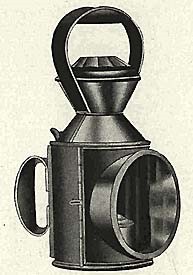
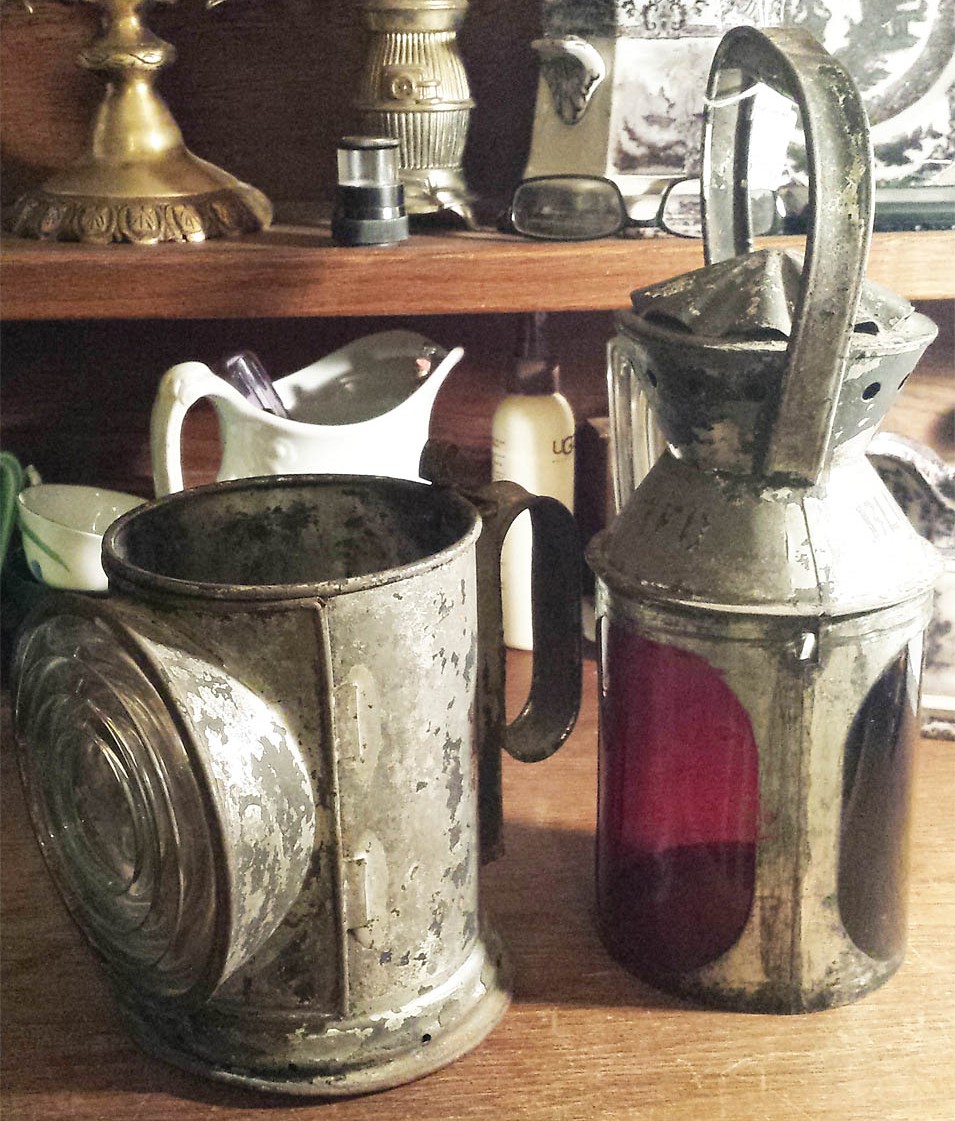
NOTE: I found a British version to add to my collection but would still love to have an American version.
21) Any Casey lantern with marked globe and frame. I'd also consider unmarked globes.
22) SOUTHERN RY short globe lantern with marked red or cobalt blue globe. I prefer one with SOUTHERN RY spelled out, and in large letters (not the tiny ones). Would also consider SOU RY spelled out.
23) Unmarked Adlake lanterns and fuel founts. I use these around the house for mood lighting, and for gifts to friends. I'm looking for deals (i.e. $25 or so) so if you're looking to make money I suggest selling on Ebay.
24) Weighted locomotive cab lantern. Just a hand lantern that has a lead ring around the bottom. Want one to add to the webpage so I can share the info on how it was used.
25) Fixed globe lantern.
26) Semaphore lamp or order lamp with a blue lens. A REAL blue lens, not one that kind of looks blue but is really a signal green color. And not a purple one. These were used on doll arm posts.
Other railroad items:
27) What do you have? :)
Parts:
28) And any other lantern, lamp, globe, or part you may have to sell. If you have something, let me know. I might have a use for it. I'm also interested in other railroad items such as locks, watches, telegraphs, wax sealers, RPO mail cancellation stamps, etc.